
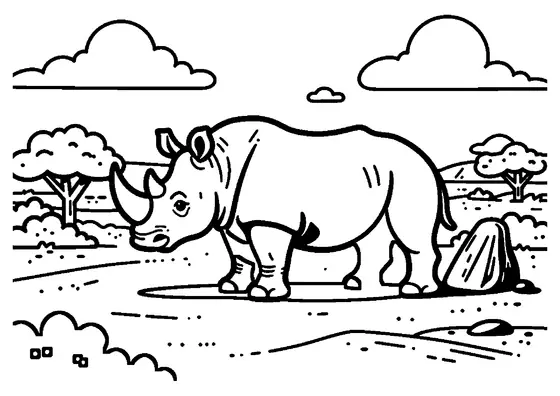
Rhino on the Etosha Salt Pan
A heavy rhinoceros stands near a weathered tree trunk across the vast cracked surface of the Etosha salt pan.

A4 format (landscape), black outlines on a white background · for home and classroom use
All coloring pages: African Animal Coloring Pages
Similar coloring pages: African Animal Coloring Pages



What else can you print? Free, no account needed
Custom Name Coloring Pages
Enter your child's name to generate a custom coloring page featuring large outline letters to color and decorate.
Open generator →Connect the Dots Generator
Eight connect-the-dots pictures across three difficulty levels. Features faint outline guides for younger children and dots only for older kids.
Open generator →Printables
Worksheets, tracing lines, mazes and dot-to-dots in A4.
Browse printables →
Rhinoceros on the Etosha Salt Pan
The Etosha Pan in Namibia is an expansive, arid salt flat characterized by dry, cracked clay and mineral deposits. Rhinoceroses traverse this open terrain in search of water holes and low shrubbery scattered across the stark landscape. Ancient dried tree trunks occasionally rise from the parched soil, standing out against the broad horizon of the salt desert.
Facts About Rhinos in Arid Salt Pans
The Etosha salt pan is so large that its bright white mineral crust can be seen from space during dry months. Rhinoceroses living near salt pans have adapted to long journeys between scarce drinking spots and mineral licks. Their thick skin folds act as natural armor, while white dust from the pan floor often coats their bodies, giving them a pale appearance.
Authentic Colors of the Salt Pan Rhino Scene
- Rhinoceros skin: slate gray, often covered in dusty off-white salt crust
- Rhino horn: dark charcoal or dark brown horn material
- Dried tree trunk: pale sun-bleached gray with dark brown cracks
- Salt pan ground: bright white, pale cream, and light gray mineral soil