
Ostrich in a Gravel Semi-Desert
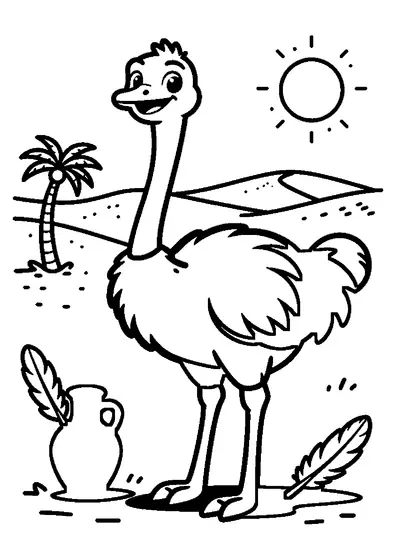
A majestic ostrich strides across a gravel semi-desert featuring scattered boulders, a weathered tree trunk, and distant flat hills.

A4 format (portrait), black outlines on a white background · for home and classroom use
All coloring pages: African Animal Coloring Pages
Similar coloring pages: African Animal Coloring Pages



What else can you print? Free, no account needed
Custom Name Coloring Pages
Enter your child's name to generate a custom coloring page featuring large outline letters to color and decorate.
Open generator →Connect the Dots Generator
Eight connect-the-dots pictures across three difficulty levels. Features faint outline guides for younger children and dots only for older kids.
Open generator →Printables
Worksheets, tracing lines, mazes and dot-to-dots in A4.
Browse printables →
An Ostrich Striding Across Gravel Plains
A tall ostrich stands amid an arid gravel landscape defined by rocky ground, a fallen tree trunk, and smooth, flat hills in the distance. The bird displays its characteristic slender neck, powerful legs, and soft body plumage. In semi-desert environments, these large flightless birds roam wide open spaces in search of seeds, roots, leaves, and small insects.
Adaptations for Semi-Desert Survival
Ostriches thrive in semi-deserts where rocky terrain and gravel soils make water scarce for much of the year. Their long, muscular legs feature two large toes, which reduce friction and help them reach impressive running speeds of over forty miles per hour. Sparse vegetation and weathered tree trunks offer perches for smaller desert birds, while ostriches rely on open vistas to stay alert to predators.
Authentic Colors of the Ostrich and Desert Landscape
- Male ostrich body feathers: deep jet-black
- Female ostrich body feathers: earthy grayish-brown
- Wing and tail plumes: stark white or pale ivory
- Ostrich neck and leg skin: pale pinkish-gray or light tan
- Desert gravel and boulders: warm ochre, sandy gray, and rust red