
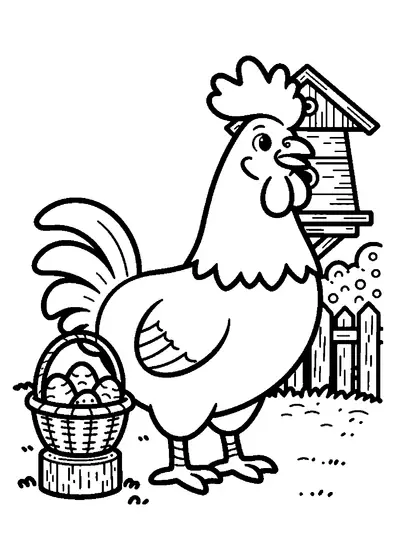
Proud Rooster by a Farm Fence at Daybreak
A proud rooster greets daybreak by a woven farm fence, with a jug and a basket of Easter eggs beside him.

A4 format (portrait), black outlines on a white background · for home and classroom use
All coloring pages: Farm Animal Coloring Pages
Similar coloring pages: Farm Animal Coloring Pages



What else can you print? Free, no account needed
Custom Name Coloring Pages
Enter your child's name to generate a custom coloring page featuring large outline letters to color and decorate.
Open generator →Connect the Dots Generator
Eight connect-the-dots pictures across three difficulty levels. Features faint outline guides for younger children and dots only for older kids.
Open generator →Printables
Worksheets, tracing lines, mazes and dot-to-dots in A4.
Browse printables →
A rooster in the farmyard at daybreak
The rooster stands beside a woven fence with his large comb held high. A jug and a basket of Easter eggs complete the rustic farmyard setting as morning begins. His upright posture and prominent head feathers give him the commanding appearance commonly associated with a farmyard rooster.
Morning facts about roosters
Roosters often crow around dawn, but they may also call at other times to communicate and announce their presence. Their internal body clock helps them anticipate the morning even before the surroundings become fully bright. A rooster also uses different calls to warn the flock of possible danger or draw attention to food.
Real-life colors of the rooster and farm objects
- Comb and wattles: vivid red
- Beak and legs: pale yellow, horn-colored, or gray, depending on the breed
- Neck and body feathers: combinations of white, black, red, brown, gold, or copper
- Woven fence: tan, brown, or weathered gray
- Jug and basket: earthy terracotta or brown jug with a straw-colored or brown basket