
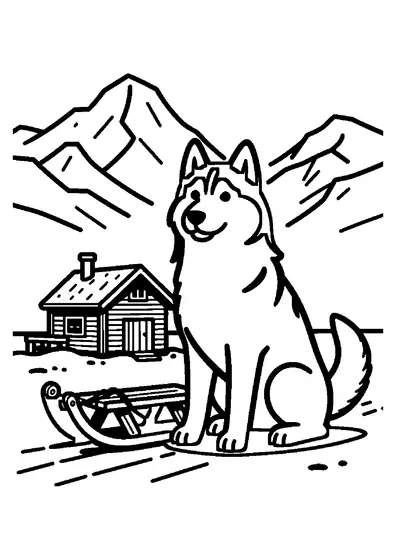
Husky in a Snowy Forest Clearing
A thick-coated husky gathers in a snow-covered forest glade alongside a timber cabin and a wooden sled.

A4 format (landscape), black outlines on a white background · for home and classroom use
All coloring pages: Dog Breed Coloring Pages
Similar coloring pages: Dog Breed Coloring Pages


What else can you print? Free, no account needed
Custom Name Coloring Pages
Enter your child's name to generate a custom coloring page featuring large outline letters to color and decorate.
Open generator →Connect the Dots Generator
Eight connect-the-dots pictures across three difficulty levels. Features faint outline guides for younger children and dots only for older kids.
Open generator →Printables
Worksheets, tracing lines, mazes and dot-to-dots in A4.
Browse printables →
Husky in a Winter Woodland Setting
This scene features a husky surrounded by snowy forest trees in a remote woodland clearing. The outdoor environment includes a wooden log cabin and a traditional sled designed for snow travel.
Sled Dogs in Cold Northern Climates
Siberian Huskies possess a dense double coat consisting of a soft undercoat and top guard hairs that retain body heat in freezing temperatures. Wooden sleds have served as vital transportation across Arctic wilderness regions for thousands of years, relying on dog teams for traction. Snow-covered evergreen forests remain quiet during deep winter because snow acts as a natural acoustic insulator.
Authentic Colors of the Winter Scene
- Husky coat: black and white, gray and white, or copper-red and white
- Husky eyes: icy blue, warm brown, or one blue and one brown
- Wooden sled: dark stained timber with polished metal runners
- Evergreen forest trees: deep green needles beneath white snow