
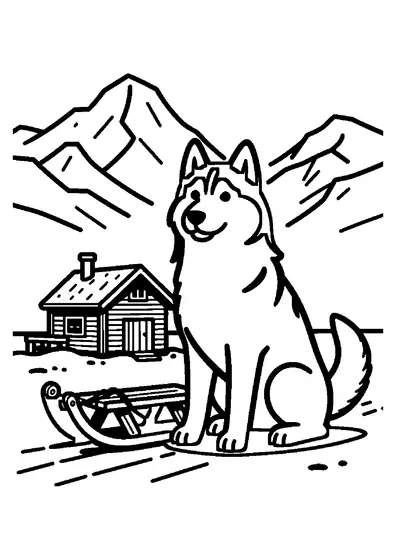
Siberian Husky in a Snowy Wood Yard
A northern sled dog pauses outdoors amid crisp snow next to stacked timber logs and a traditional wooden sledge.

A4 format (landscape), black outlines on a white background · for home and classroom use
All coloring pages: Dog Breed Coloring Pages
Similar coloring pages: Dog Breed Coloring Pages


What else can you print? Free, no account needed
Custom Name Coloring Pages
Enter your child's name to generate a custom coloring page featuring large outline letters to color and decorate.
Open generator →Connect the Dots Generator
Eight connect-the-dots pictures across three difficulty levels. Features faint outline guides for younger children and dots only for older kids.
Open generator →Printables
Worksheets, tracing lines, mazes and dot-to-dots in A4.
Browse printables →
A Siberian Husky in a Winter Wood Yard
Cold-climate yards during winter months are essential hubs for storing heating timber and winter transportation gear. In a snow-covered yard, a Siberian husky stands beside a classic wooden sled along with a neatly arranged pile of chopped firewood.
Adaptations of Siberian Huskies for Arctic Conditions
Siberian huskies were developed by the Chukchi people of northeastern Asia as endurance sled dogs capable of traveling vast distances over frozen terrain. Their almond-shaped eyes protect against blowing snow glare, while their bushy tails can wrap over their noses to warm cold air before breathing during rest. Their thick insulating double coat maintains body warmth even in temperatures far below zero.
Natural Colors of a Snowy Yard Environment
- Siberian husky fur: Combinations of black, gray, copper, or red mixed with white markings
- Husky eye color: Ice blue, dark brown, or heterochromatic with one blue and one brown eye
- Firewood logs: Brown bark with pale tan or yellowish freshly split inner wood
- Wooden sled runner frame: Natural ash timber brown, dark walnut, or varnished oak
- Snow blanket: Pure brilliant white with soft icy blue shadow tones