
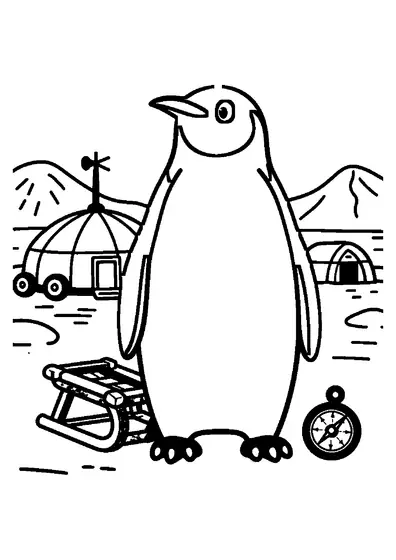
Emperor Penguin at a Polar Research Camp
An emperor penguin pauses next to scientific measuring equipment and a weather tent set up in Antarctic snow.

A4 format (landscape), black outlines on a white background · for home and classroom use
All coloring pages: Penguin Coloring Pages
Similar coloring pages: Penguin Coloring Pages


What else can you print? Free, no account needed
Custom Name Coloring Pages
Enter your child's name to generate a custom coloring page featuring large outline letters to color and decorate.
Open generator →Connect the Dots Generator
Eight connect-the-dots pictures across three difficulty levels. Features faint outline guides for younger children and dots only for older kids.
Open generator →Printables
Worksheets, tracing lines, mazes and dot-to-dots in A4.
Browse printables →
Emperor Penguin Near a Scientific Outpost
An emperor penguin stands in the snow beside a polar measuring pole and a research tent. The surrounding environment represents a remote research camp where scientists study wildlife and polar climate conditions.
Antarctic Science and Wildlife
Polar research camps rely on specialized equipment to record weather patterns, ice thickness, and animal behaviors in extreme sub-zero conditions. Scientists often set up sturdy, wind-resistant tents that can withstand fierce blizzard winds on open ice sheets. Emperor penguins often display curiosity toward human equipment when scientists keep a respectful distance.
Real Colors of Emperor Penguins and Polar Equipment
- Emperor penguin head and back: deep black
- Emperor penguin chest and belly: clean white
- Neck mark: bright yellow fading into orange
- Beak: black with a pinkish-orange stripe on the lower jaw
- Research tent: high-visibility orange or yellow fabric
- Measuring pole: black and white contrasting stripes