
Parrot on a Branch
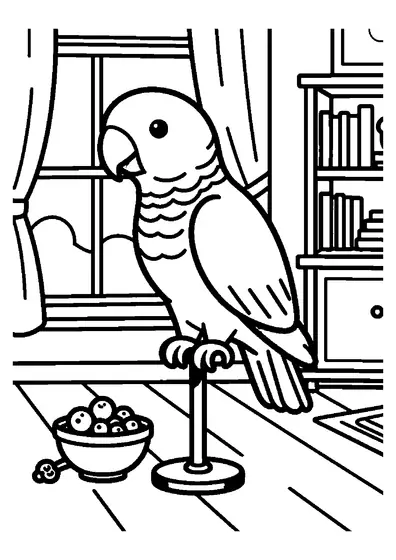
An exotic parrot perches quietly on a curved branch, with its hooked beak and feathered body fully visible.

A4 format (portrait), black outlines on a white background · for home and classroom use
All coloring pages: Parrot and Flamingo Coloring Pages
Similar coloring pages: Parrot and Flamingo Coloring Pages



What else can you print? Free, no account needed
Custom Name Coloring Pages
Enter your child's name to generate a custom coloring page featuring large outline letters to color and decorate.
Open generator →Connect the Dots Generator
Eight connect-the-dots pictures across three difficulty levels. Features faint outline guides for younger children and dots only for older kids.
Open generator →Printables
Worksheets, tracing lines, mazes and dot-to-dots in A4.
Browse printables →
What the Parrot on a Branch Page Shows
The bird sits upright on a single bending branch with its feet wrapped around the wood. Its large curved beak, rounded head, chest, wings, and long tail feathers form the main parts of the scene. No other animals, plants, or background objects surround the perched parrot.
Interesting Facts About Perching Parrots
A parrot can grip a branch securely because two toes point forward and two point backward on each foot. This arrangement also helps many parrots hold and turn food while eating.
Real-Life Colors of Parrots
- Head feathers: may be green, red, blue, yellow, white, gray, or a combination of colors
- Chest feathers: often green, red, yellow, blue, or gray, depending on the species
- Wing feathers: commonly green or blue, sometimes with red, yellow, or black markings
- Curved beak: may be black, dark gray, ivory, or pale horn-colored
- Branch: usually tan, brown, gray-brown, or reddish brown