
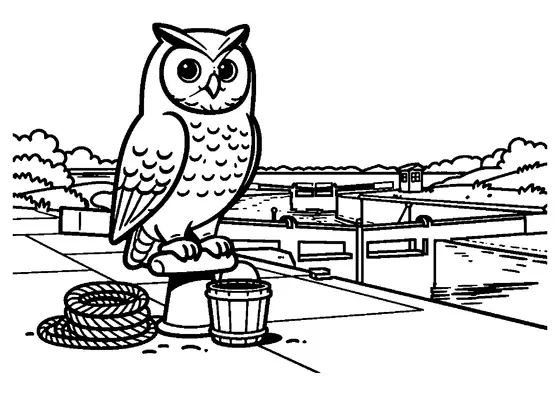
Little Owl in Ancient Roman Baths
A compact raptor sits atop historical stonework near water basins and clay vessels.

A4 format (portrait), black outlines on a white background · for home and classroom use
All coloring pages: Owl Coloring Pages
Similar coloring pages: Owl Coloring Pages




What else can you print? Free, no account needed
Custom Name Coloring Pages
Enter your child's name to generate a custom coloring page featuring large outline letters to color and decorate.
Open generator →Connect the Dots Generator
Eight connect-the-dots pictures across three difficulty levels. Features faint outline guides for younger children and dots only for older kids.
Open generator →Printables
Worksheets, tracing lines, mazes and dot-to-dots in A4.
Browse printables →
Little Owl Among Roman Ruins
A little owl perches on a stone pedestal beside a clay amphora and a water pool. Architectural stone structures and ancient Roman bath ruins frame the surrounding scene.
Symbolism and Habitat of the Little Owl
The little owl has been closely associated with Mediterranean architecture and ancient history for thousands of years, famously serving as the symbol of Athena in classical antiquity. These small birds frequently nest in stone crevices, old masonry, and ruined arches where hollows provide shelter. Ancient stone structures attract insects and small lizards, providing abundant food.
Colors of Ancient Stonework and Wildlife
- Little owl feathers: Mottled brown with white specks and streaks
- Little owl eyes: Pale yellow with dark pupils
- Stone pedestal and ruins: Warm limestone beige, sandy buff, or weathered gray
- Clay amphora: Terracotta orange, reddish brown, or muted earth tan
- Pool water: Clear turquoise, soft blue, or greenish blue