
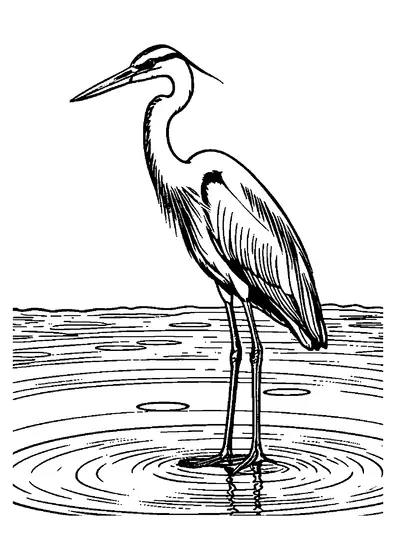
Heron Among the Pond Reeds Coloring Page
A tall heron wades quietly along a peaceful pond shore framed by thick cattails and a weathered tree trunk.

A4 format (landscape), black outlines on a white background · for home and classroom use
All coloring pages: Bird Coloring Pages
Similar coloring pages: Bird Coloring Pages



What else can you print? Free, no account needed
Custom Name Coloring Pages
Enter your child's name to generate a custom coloring page featuring large outline letters to color and decorate.
Open generator →Connect the Dots Generator
Eight connect-the-dots pictures across three difficulty levels. Features faint outline guides for younger children and dots only for older kids.
Open generator →Printables
Worksheets, tracing lines, mazes and dot-to-dots in A4.
Browse printables →
Coastal and Wetland Herons by the Pond
Herons are large water birds frequently seen wading along shallow pond edges, riverbanks, and marshy embankments. Their slender bodies and long legs allow them to navigate quiet reed beds while searching for small fish, frogs, and aquatic insects hidden beneath the water surface.
How Herons Adapt to Freshwater Habitats
Herons possess specialized neck vertebrae that fold into an S-shape, allowing them to strike forward with sudden speed. Standing completely still near fallen tree trunks and thick cattail vegetation helps them blend into wetland surroundings and ambush unsuspecting prey.
Natural Colors of a Pond Heron
- Heron feathers: Slate gray, blue-gray, white, and soft charcoal
- Heron beak and legs: Dull yellow, brownish yellow, or orange
- Cattails: Dark brown velvet heads with bright green stalks
- Reed bed: Deep green in summer turning golden beige in autumn
- Tree trunk: Weathered gray-brown bark with patches of green moss