
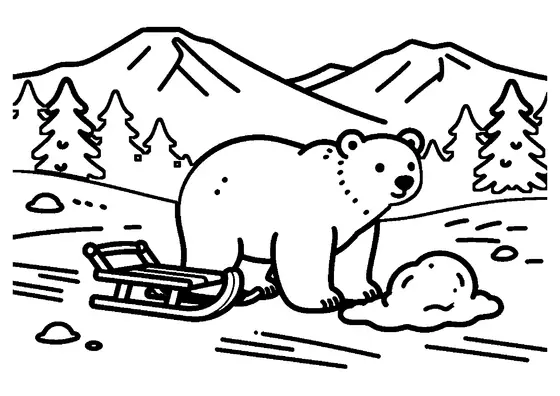
Polar Bear on a Snowy Wooden Bridge
A polar bear travels across a small wooden bridge set within a cold, snow-filled winter environment.

A4 format (portrait), black outlines on a white background · for home and classroom use
All coloring pages: Bear Coloring Pages
Similar coloring pages: Bear Coloring Pages


What else can you print? Free, no account needed
Custom Name Coloring Pages
Enter your child's name to generate a custom coloring page featuring large outline letters to color and decorate.
Open generator →Connect the Dots Generator
Eight connect-the-dots pictures across three difficulty levels. Features faint outline guides for younger children and dots only for older kids.
Open generator →Printables
Worksheets, tracing lines, mazes and dot-to-dots in A4.
Browse printables →
A Polar Bear Crossing a Snowy Wooden Bridge
This scene portrays a polar bear situated on a wooden bridge amidst a snow-covered winter landscape. Bridges in arctic and subarctic regions are typically built from sturdy timber treated to withstand extreme subzero temperatures and heavy snow accumulation. Such structures allow animals and researchers alike to traverse frozen streams and snow-drifted channels safely without breaking through fragile ice layers.
Adaptation of Paws to Ice and Snow
Polar bear paws can measure up to twelve inches across, acting like natural snowshoes to distribute the animal's heavy weight across thin ice and deep snow. The soles of their feet are covered with small bumps called papillae, which create friction and prevent slipping on slick icy surfaces. Additionally, stiff fur grows between their toes to insulate their feet against freezing ground temperatures while walking across timber bridges or snowbanks.
Natural Colors of Polar Bears and Winter Scenery
- Polar bear fur: translucent white or light cream appearance that reflects surrounding snow and sunlight
- Polar bear skin and snout: jet black skin beneath the fur, with a solid black nose and dark eyes
- Wooden bridge: weathered brown, ash gray, or aged timber tone
- Snowy landscape: pure white snow drifts with icy blue undertones in shadowed areas