
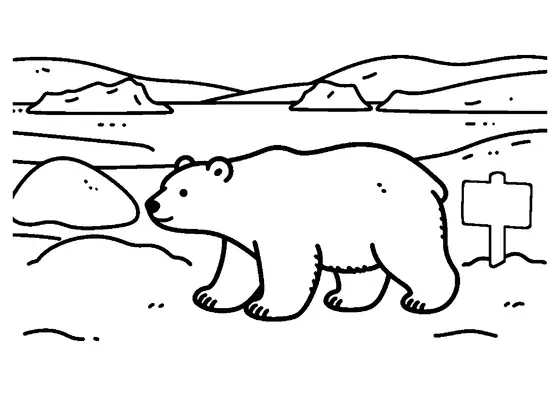
Polar Bear Beside an Ice-Covered Boulder
Arctic predators navigate frozen shorelines and icy terrain in search of food during the cold polar winter.

A4 format (landscape), black outlines on a white background · for home and classroom use
All coloring pages: Bear Coloring Pages
Similar coloring pages: Bear Coloring Pages




What else can you print? Free, no account needed
Custom Name Coloring Pages
Enter your child's name to generate a custom coloring page featuring large outline letters to color and decorate.
Open generator →Connect the Dots Generator
Eight connect-the-dots pictures across three difficulty levels. Features faint outline guides for younger children and dots only for older kids.
Open generator →Printables
Worksheets, tracing lines, mazes and dot-to-dots in A4.
Browse printables →
Polar Bears Navigating Arctic Landscapes
A large polar bear walks across frozen, snow-covered Arctic ground. A frost-coated boulder sits along the barren landscape near a weathered piece of driftwood washed ashore from northern ocean currents.
Adaptations of Arctic Marine Mammals
Polar bears are officially classified as marine mammals because they spend most of their lives traveling on frozen sea ice. Their thick fur appears white or creamy yellow, but their hair shafts are actually transparent and hollow to trap heat from sunlight directly against their jet-black skin. Driftwood found on Arctic shores often travels thousands of miles down Siberian rivers before freezing into pack ice and washing onto rocky tundra coasts.
True Colors of the Arctic Environment
- Polar bear fur: Off-white, ivory, soft cream, or pale yellow in bright sunlight.
- Polar bear nose and skin: Pure jet black around the muzzle, eyes, and footpads.
- Arctic snow and ice: Brilliant white, pale sky blue, or light aqua in shadow areas.
- Driftwood log: Bleached silver-gray, pale driftwood tan, or weathered brown.
- Glacial boulder: Dark granite gray, charcoal, or blue-gray with white frost.