
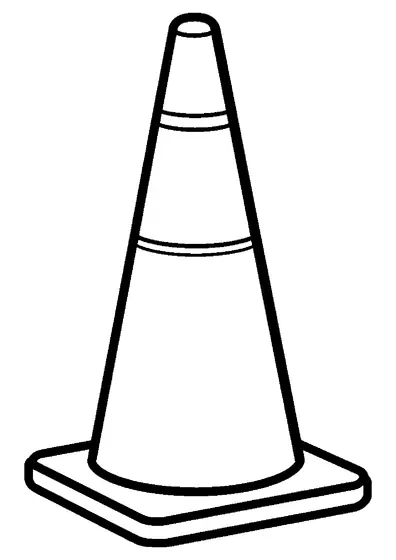
Traffic Cone Front View
A tall safety cone with a wide square base stands ready to guide road traffic around work zones.

A4 format (portrait), black outlines on a white background · for home and classroom use
All coloring pages: Excavator and Construction Vehicle Coloring Pages
Similar coloring pages: Excavator and Construction Vehicle Coloring Pages


What else can you print? Free, no account needed
Custom Name Coloring Pages
Enter your child's name to generate a custom coloring page featuring large outline letters to color and decorate.
Open generator →Connect the Dots Generator
Eight connect-the-dots pictures across three difficulty levels. Features faint outline guides for younger children and dots only for older kids.
Open generator →Printables
Worksheets, tracing lines, mazes and dot-to-dots in A4.
Browse printables →
Road Safety Traffic Cone
Traffic cones serve as essential visual markers along streets, highways, and active work zones. Looking at the cone from the front emphasizes its tall conical body, its prominent horizontal reflective stripe, and its broad square base designed to maintain stability.
Surprising Facts About Traffic Cones
Traffic cones were invented in the 1940s to replace heavy wooden barricades that were easy to damage and hard to transport. Modern traffic cones are made from flexible polyvinyl chloride, allowing them to spring back into shape if knocked over by a vehicle. Their bright neon hue ensures drivers can spot them from long distances day or night.
Authentic Colors of Traffic Cones
- Conical body: fluorescent orange, bright green, or high-visibility yellow
- Reflective horizontal stripe: silver, white, or reflective light gray
- Heavy base: dark black, dark gray, or matching bright orange rubber
- Base underside: recycled black synthetic rubber