
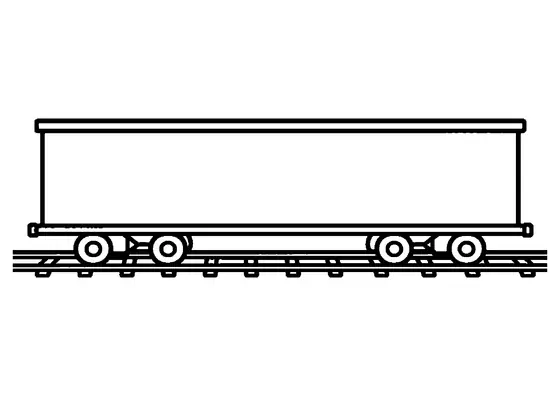
Railway freight car on tracks with buffers
A standalone railway freight wagon rests on straight parallel tracks in a profile side view.

A4 format (landscape), black outlines on a white background · for home and classroom use
All coloring pages: Train Coloring Pages
Similar coloring pages: Train Coloring Pages


What else can you print? Free, no account needed
Custom Name Coloring Pages
Enter your child's name to generate a custom coloring page featuring large outline letters to color and decorate.
Open generator →Connect the Dots Generator
Eight connect-the-dots pictures across three difficulty levels. Features faint outline guides for younger children and dots only for older kids.
Open generator →Printables
Worksheets, tracing lines, mazes and dot-to-dots in A4.
Browse printables →
Profile View of a Single Railway Freight Car
A single railway car sits stationary on steel track rails. The design features the main car body structure alongside the undercarriage, wheels, and front buffers.
The Function of Railway Buffers and Couplers
Buffers are spring-loaded steel pads mounted on the front and rear ends of European train cars to absorb shocks when cars bump together. Railroad cars rely on sturdy steel undercarriages called bogies to distribute weight evenly across multiple axles. Freight wagons can travel thousands of miles across connected rail systems carrying raw materials between factory hubs.
Typical Colors of Railroad Cars
- Railway wagon body: oxide red, deep blue, dark brown, or safety yellow
- Wheel sets and axles: dark slate gray or weathered black metal
- Steel buffers: black iron or grease-stained dark gray
- Running track rails: metallic silver on top with reddish-rust sides
- Track ballast stones: neutral gray, beige, or tan granite gravel