
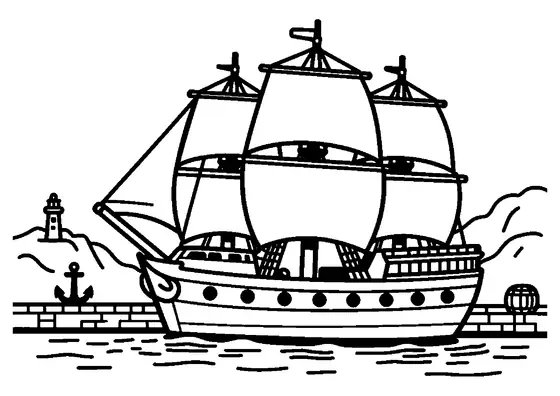
Three-Masted Sailing Ship at Sea
A classic vessel with three tall masts navigates open ocean waters with sails fully raised.

A4 format (portrait), black outlines on a white background · for home and classroom use
All coloring pages: Vehicle Coloring Pages
Similar coloring pages: Vehicle Coloring Pages



What else can you print? Free, no account needed
Custom Name Coloring Pages
Enter your child's name to generate a custom coloring page featuring large outline letters to color and decorate.
Open generator →Connect the Dots Generator
Eight connect-the-dots pictures across three difficulty levels. Features faint outline guides for younger children and dots only for older kids.
Open generator →Printables
Worksheets, tracing lines, mazes and dot-to-dots in A4.
Browse printables →
Traditional Sailing Vessel on Open Waters
Ocean travel historically relied on large wooden vessels equipped with multiple masts and expansive canvas sails. Floating upon rolling ocean waves, a traditional three-masted ship demonstrates how wind power moves large vessels across deep waters.
How Three-Masted Vessels Handled the High Seas
Each mast on a traditional three-masted ship carried specific names: the foremast at the front, the mainmast in the middle, and the mizzenmast near the stern. By adjusting the angle of the canvas sails on each mast, sailors captured wind from different directions to steer efficiently across long distances. Large ocean-going ships depended on skilled crews to pull heavy rigging ropes and manage sails during changing weather.
Authentic Colors of a Historic Sailing Ship
- Wooden hull: Rich brown, dark oak, or black with painted trim
- Fabric sails: Off-white, cream, or light tan canvas
- Wooden masts and spars: Natural light timber or varnished wood
- Ocean water: Deep blue, turquoise, or dark navy blue with white foam capped crests