
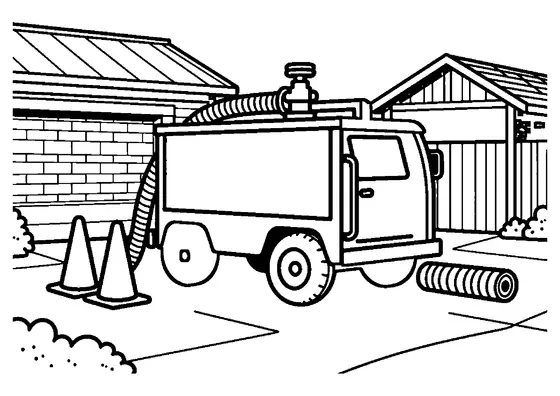
Firefighting Rail Tanker by a Loading Platform
A specialized railway tank car equipped with emergency water hoses rests along an industrial loading dock.

A4 format (landscape), black outlines on a white background · for home and classroom use
All coloring pages: Firefighter and Police Coloring Pages
Similar coloring pages: Firefighter and Police Coloring Pages



What else can you print? Free, no account needed
Custom Name Coloring Pages
Enter your child's name to generate a custom coloring page featuring large outline letters to color and decorate.
Open generator →Connect the Dots Generator
Eight connect-the-dots pictures across three difficulty levels. Features faint outline guides for younger children and dots only for older kids.
Open generator →Printables
Worksheets, tracing lines, mazes and dot-to-dots in A4.
Browse printables →
Railbound Fire Protection Equipment
Railroad companies and municipal departments maintain specialized firefighting rail tankers equipped with large water tanks, pump stands, and heavy hoses. Parked beside elevated railway loading platforms, these railcars protect timber trestles and remote tracks from wildland fires.
Industrial Railway Fire Suppression
Firefighting trains were developed during the expansion of timber and coal railways to suppress forest fires sparked by iron locomotive wheels. A single firefighting rail tanker can carry up to 10,000 gallons of water to regions unreachable by standard road-bound fire engines.
Colors of Industrial Rail Tankers
- Rail tanker body: safety red, yellow, or industrial black
- Steel railway tracks: metallic dark gray with rust-brown sides
- Heavy hose line: dark gray, black, or canvas yellow
- Loading platform: weathered timber brown or concrete gray