
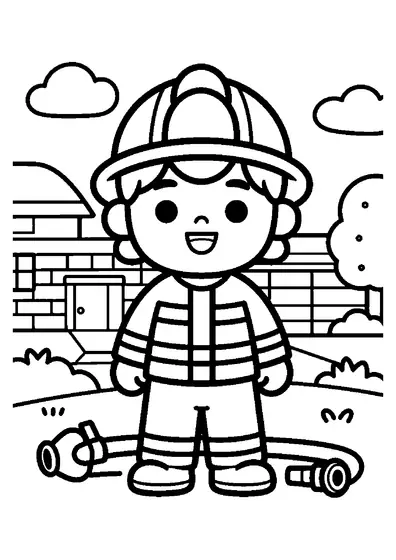
Smiling firefighter next to a hose and nozzle
A uniformed firefighter stands alongside a coiled discharge hose fitted with a heavy adjustable nozzle.

A4 format (portrait), black outlines on a white background · for home and classroom use
All coloring pages: Fire Truck Coloring Pages
Similar coloring pages: Fire Truck Coloring Pages


What else can you print? Free, no account needed
Custom Name Coloring Pages
Enter your child's name to generate a custom coloring page featuring large outline letters to color and decorate.
Open generator →Connect the Dots Generator
Eight connect-the-dots pictures across three difficulty levels. Features faint outline guides for younger children and dots only for older kids.
Open generator →Printables
Worksheets, tracing lines, mazes and dot-to-dots in A4.
Browse printables →
Firefighters and Fire Hose Equipment
Firefighters rely on specialized heavy-duty hoses to deliver high volumes of water directly to the source of a blaze. Hoses are constructed from woven synthetic fibers with rubber liners to withstand extreme water pressure and rough ground conditions. Understanding how to handle water delivery lines is one of the fundamental skills learned during professional fire academy training.
Fire Hose Operation and Maintenance
A standard attack hose can handle water pressures exceeding two hundred pounds per square inch, requiring firm control by trained personnel. The brass or aluminum nozzle at the end allows firefighters to adjust the stream from a solid straight jet to a wide protective fog pattern. After every emergency call, hoses are thoroughly washed, tested for leaks, and hung in dry towers to prevent mildew.
Authentic Colors of Firefighting Gear
- Protective jacket and pants: tan, dark navy blue, or black
- Firefighter helmet: red, yellow, black, or white
- Rubber hose casing: yellow, red, white, or dull gray
- Nozzle body and couplings: silver aluminum or gold brass
- Heavy work gloves and boots: black leather with yellow trim