
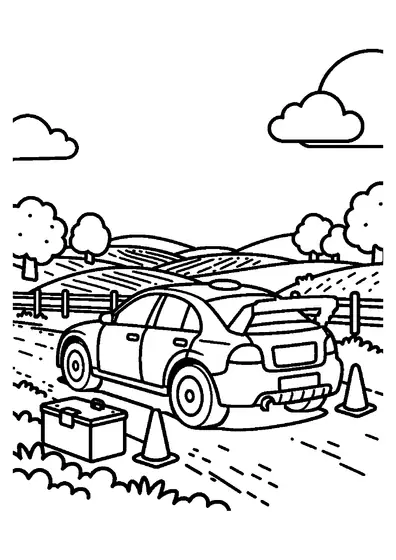
Track Car at Pit Stop Line
A low-slung track car featuring a large front air intake and widened fenders pauses behind a painted pavement stop mark.

A4 format (landscape), black outlines on a white background · for home and classroom use
All coloring pages: Sports Car Coloring Pages
Similar coloring pages: Sports Car Coloring Pages



What else can you print? Free, no account needed
Custom Name Coloring Pages
Enter your child's name to generate a custom coloring page featuring large outline letters to color and decorate.
Open generator →Connect the Dots Generator
Eight connect-the-dots pictures across three difficulty levels. Features faint outline guides for younger children and dots only for older kids.
Open generator →Printables
Worksheets, tracing lines, mazes and dot-to-dots in A4.
Browse printables →
Front View of Track Cars at Pit Markings
Built low to the ground for optimal stability, track cars utilize enlarged front air intakes to channel cooling air directly toward high-temperature engine radiators. Flares on the wide fenders cover enlarged competition tires, while painted pavement markings indicate precise stopping points for staging and pit lane checks.
Engine Air Intake Functions in Racing
Front-mounted air intakes capture high-pressure air while the race vehicle moves forward at elevated speeds. This steady airflow cools engine components and brake systems, preventing overheating during long endurance races under hot weather conditions.
Colors of Race Track Vehicles
- Front body panels: vibrant crimson red, bright white, or sky blue finish
- Front air intake grilles: dark matte black or graphite gray mesh
- Wide fender flares: body-matched paint or raw black carbon composite
- Painted pavement mark: crisp white or high-visibility yellow road paint