
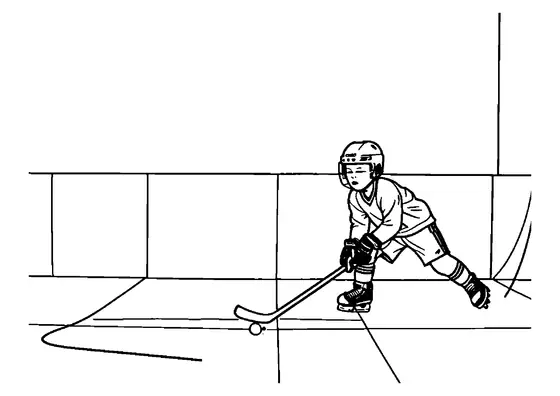
Hockey Player Skating Around Two Pucks
A top-down view presents a vast oval hockey rink with marked zones and a small player handling a puck near its center.

A4 format (landscape), black outlines on a white background · for home and classroom use
All coloring pages: Winter Sports Coloring Pages
Similar coloring pages: Winter Sports Coloring Pages




What else can you print? Free, no account needed
Custom Name Coloring Pages
Enter your child's name to generate a custom coloring page featuring large outline letters to color and decorate.
Open generator →Connect the Dots Generator
Eight connect-the-dots pictures across three difficulty levels. Features faint outline guides for younger children and dots only for older kids.
Open generator →Printables
Worksheets, tracing lines, mazes and dot-to-dots in A4.
Browse printables →
The hockey player on the marked rink
The scene looks down over an oval ice surface whose markings divide the playing area and show the goal zones. A small hockey player stands near the center with a stick and puck. The broad view emphasizes the size of the rink compared with the player and shows how rink markings organize a game.
How rink markings guide hockey play
Lines and marked zones help players and officials determine where particular rules apply. The center area is important when play begins again after certain stoppages, while goal areas identify the space around each net. Players learn to notice these markings even while skating quickly and watching the puck.
Real-life colors found on a hockey rink
- Ice surface: white or very pale blue under arena lighting
- Center and boundary markings: commonly red and blue
- Goal areas: often pale blue with red boundaries
- Hockey puck: usually black
- Player's uniform and stick: team colors with a black, white, or natural wood-toned stick