
Cross-Country Skier by Frozen Stream
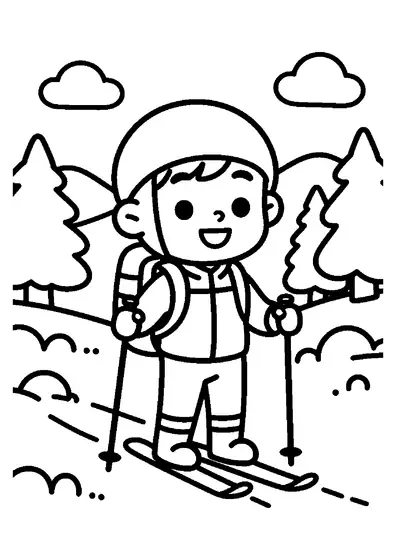
A young cross-country skier wearing a backpack pauses with his poles along a quiet trail beside a frozen stream.

A4 format (landscape), black outlines on a white background · for home and classroom use
All coloring pages: Winter Sports Coloring Pages
Similar coloring pages: Winter Sports Coloring Pages



What else can you print? Free, no account needed
Custom Name Coloring Pages
Enter your child's name to generate a custom coloring page featuring large outline letters to color and decorate.
Open generator →Connect the Dots Generator
Eight connect-the-dots pictures across three difficulty levels. Features faint outline guides for younger children and dots only for older kids.
Open generator →Printables
Worksheets, tracing lines, mazes and dot-to-dots in A4.
Browse printables →
Cross-Country Skiing Along a Winter Stream
A boy equipped with long cross-country skis, lightweight poles, and a gear backpack takes a break on a flat snow-covered path. The trail runs right beside a creek frozen over with winter ice.
How Cross-Country Skis Work on Flat Trails
Unlike downhill skiing, cross-country skiing relies on human power to glide across flat or rolling terrain. Special wax or fish-scale textures on the bottom of the skis grip the snow when pushing off, then allow the ski to slide forward smoothly. Lightweight poles help skiers propel themselves forward and maintain rhythm over long winter distances.
Colors of Cross-Country Gear and Streams
- Cross-country skis: Bright yellow, blue, or sleek black with colored accents
- Ski poles: Metallic silver aluminum or carbon gray with black grips
- Hiker backpack: Outdoor red, orange, or navy blue canvas
- Frozen stream ice: Milky white, pale cyan, or clear gray-blue
- Stream bank snow: Pure white with soft shadow tones