
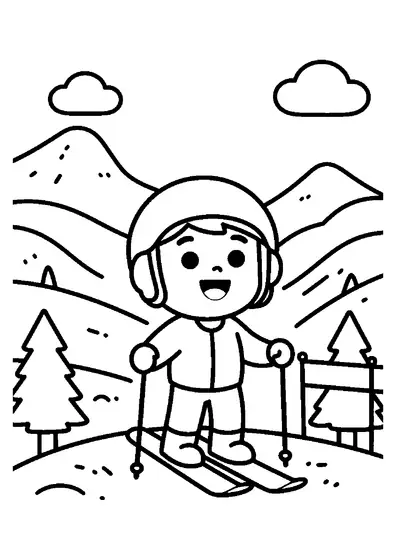
Boy with Sled on Snowy Hill
A helmeted boy stands beside a sled on a gentle snow-covered slope during a winter outing.

A4 format (portrait), black outlines on a white background · for home and classroom use
All coloring pages: Winter Sports Coloring Pages
Similar coloring pages: Winter Sports Coloring Pages

What else can you print? Free, no account needed
Custom Name Coloring Pages
Enter your child's name to generate a custom coloring page featuring large outline letters to color and decorate.
Open generator →Connect the Dots Generator
Eight connect-the-dots pictures across three difficulty levels. Features faint outline guides for younger children and dots only for older kids.
Open generator →Printables
Worksheets, tracing lines, mazes and dot-to-dots in A4.
Browse printables →
Winter Sledding on a Snow-Covered Hill
A cheerful boy wearing protective headgear stands alongside a sled positioned on a gradual winter slope. Gentle hills offer a safe environment for traditional winter recreation, allowing riders to slide down controlled inclines. Wearing appropriate safety gear helps protect children while enjoying outdoor snow activities.
Facts About Sleds and Winter Physics
Traditional sled runners reduce friction by distributing weight over thin metal or smooth plastic strips that glide across ice and packed snow. Sliding downhill relies on gravity pulling the sled downward, while friction from the snow slowly reduces speed as the slope flattens out. Steering a basic sled is accomplished by leaning body weight or pulling on attached hand ropes.
Natural Colors of Sleds and Winter Equipment
- Safety helmet: bright orange, electric blue, or dark red
- Sled frame: dark blue, bright yellow, or natural wood grain
- Sled runners: silver steel or dark gray plastic
- Snow-covered hill surface: pure white with light blue shadows