
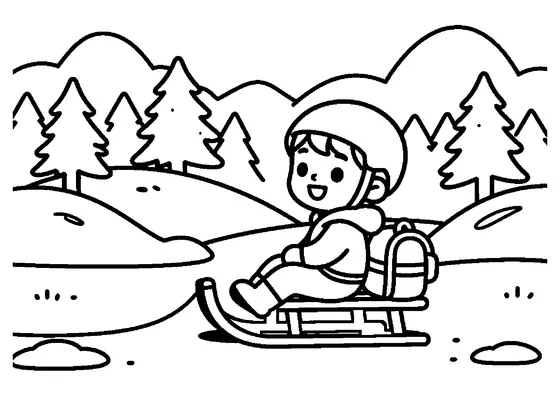
Boy Resting on a Sled
A happy child takes a calm pause on a classic wooden toboggan at the base of a snow-covered hillside framed by winter trees.

A4 format (landscape), black outlines on a white background · for home and classroom use
All coloring pages: Winter Sports Coloring Pages
Similar coloring pages: Winter Sports Coloring Pages


What else can you print? Free, no account needed
Custom Name Coloring Pages
Enter your child's name to generate a custom coloring page featuring large outline letters to color and decorate.
Open generator →Connect the Dots Generator
Eight connect-the-dots pictures across three difficulty levels. Features faint outline guides for younger children and dots only for older kids.
Open generator →Printables
Worksheets, tracing lines, mazes and dot-to-dots in A4.
Browse printables →
Winter Sledding in the Forest
A snowy forest landscape forms a quiet backdrop at the foot of a snowy hill. A smiling boy sits comfortably on his large wooden sled, enjoying a restful moment after gliding down the slope.
Traditional Knowledge About Wooden Sleds
Traditional wooden sleds are crafted from steamed hardwood like ash or oak, which bends into smooth curved runners designed to glide efficiently over packed snow. Steel runners attached underneath the wooden frame reduce friction against cold snow crystals, enabling faster downhill speeds.
Authentic Colors of Winter Sledding Scenes
- Wooden sled frame: warm amber oak, natural pine, or rich reddish mahogany stain
- Sled runners: metallic silver steel or shiny iron gray
- Boy's winter coat: bright primary colors like cherry red, royal blue, or yellow
- Snow cover: pure brilliant white with soft cool blue shadow tones
- Evergreen forest trees: deep pine green, spruce green, and snowy white branches