
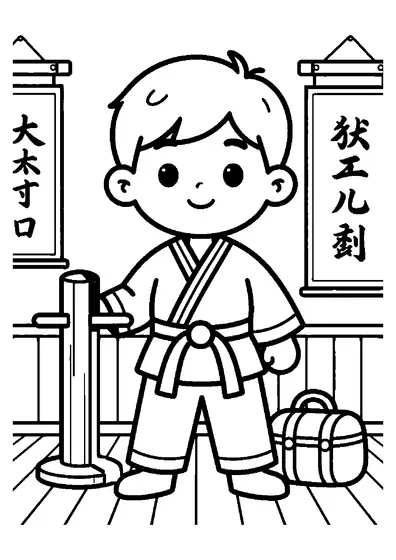
Karate Kid in White Gi
A young karate student stands in a relaxed posture wearing a traditional white gi uniform secured with a tied fabric waist belt.

A4 format (portrait), black outlines on a white background · for home and classroom use
All coloring pages: Sports Coloring Pages
Similar coloring pages: Sports Coloring Pages


What else can you print? Free, no account needed
Custom Name Coloring Pages
Enter your child's name to generate a custom coloring page featuring large outline letters to color and decorate.
Open generator →Connect the Dots Generator
Eight connect-the-dots pictures across three difficulty levels. Features faint outline guides for younger children and dots only for older kids.
Open generator →Printables
Worksheets, tracing lines, mazes and dot-to-dots in A4.
Browse printables →
Presentation of a Young Karate Practitioner
A young martial artist stands calmly in a forward pose wearing a traditional white karate gi. The character features relaxed arms held naturally at the sides, accompanied by a friendly expression and a tied belt wrapped around the waist.
Traditions of Martial Arts Uniforms
The traditional karate uniform, known as a gi, is designed to allow complete freedom of movement during kicks, strikes, and stances. The waist belt not only holds the wrap-around jacket together but also signifies the practitioner's current skill level and rank within the discipline. Martial arts training emphasizes respect, self-discipline, and defensive posture rather than aggressive confrontation.
Authentic Colors of Karate Attire
- Karate gi jacket and pants: Traditionally crisp bright white, though some schools use black or navy cotton.
- Beginner waist belt: White or yellow fabric for entry-level ranks.
- Intermediate/Advanced belt: Colored green, blue, brown, or solid black as ranking progresses.
- Skin tones: Natural shades ranging from pale pinkish beige to deep warm brown.
- Hair colors: Natural human hair shades including dark brown, black, blonde, or auburn.