
Boy Walking Through an Obstacle Course
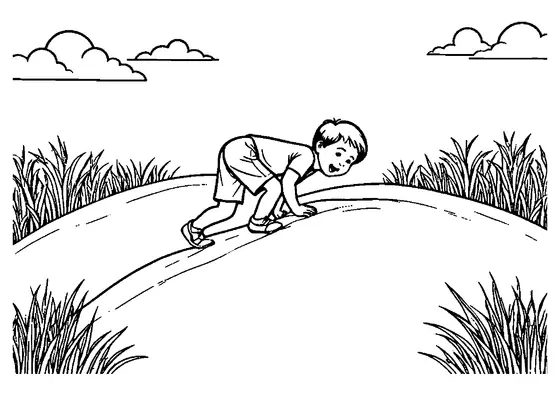
A boy moves carefully to the right across a tiled activity-room floor, stepping among round balls and other obstacles.

A4 format (landscape), black outlines on a white background · for home and classroom use
All coloring pages: Sports Coloring Pages
Similar coloring pages: Sports Coloring Pages



What else can you print? Free, no account needed
Custom Name Coloring Pages
Enter your child's name to generate a custom coloring page featuring large outline letters to color and decorate.
Open generator →Connect the Dots Generator
Eight connect-the-dots pictures across three difficulty levels. Features faint outline guides for younger children and dots only for older kids.
Open generator →Printables
Worksheets, tracing lines, mazes and dot-to-dots in A4.
Browse printables →
Crossing the Obstacle Course
Seen from the side, the boy takes a cautious step as he follows a route through the room. A group of round balls and obstacles lies near him on the tiled floor, requiring him to notice where he places his feet. A simple wall line marks the back of the room while the action centers on balance, direction, and careful movement.
What Obstacle Courses Teach
An obstacle course asks a participant to plan movements in response to objects along a route. Stepping around or between obstacles uses balance, spatial awareness, and coordination between the eyes and feet. Courses can be adjusted by changing the spacing or arrangement to suit different skill levels.
Typical Colors in an Activity Room
- Floor tiles: commonly beige, tan, gray, brown, or muted red
- Wall: often white, cream, pale blue, or another light indoor color
- Round balls: available in bright red, blue, yellow, green, or orange
- Boy’s hair and skin: natural human shades
- Boy’s clothes: varied colors such as blue, red, green, black, or gray