
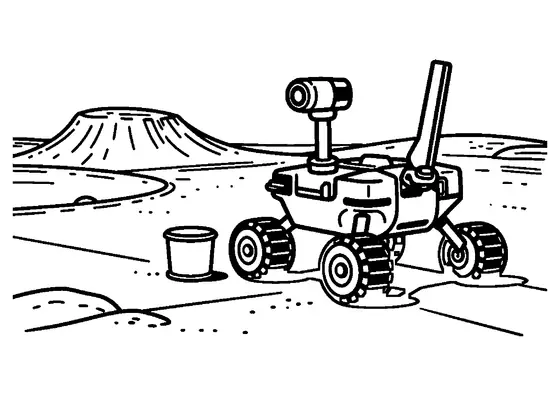
Rover examining a rock sample on Mars
A robotic space rover examines soil and rock samples across a barren Martian landscape with distant craters and plateaus.

A4 format (landscape), black outlines on a white background · for home and classroom use
All coloring pages: Space and Rocket Coloring Pages
Similar coloring pages: Space and Rocket Coloring Pages


What else can you print? Free, no account needed
Custom Name Coloring Pages
Enter your child's name to generate a custom coloring page featuring large outline letters to color and decorate.
Open generator →Connect the Dots Generator
Eight connect-the-dots pictures across three difficulty levels. Features faint outline guides for younger children and dots only for older kids.
Open generator →Printables
Worksheets, tracing lines, mazes and dot-to-dots in A4.
Browse printables →
Robotic Exploration on Mars
A scientific rover explores the dry, rocky terrain of the Red Planet. Equipped with large treaded wheels and solar or scientific panels, the vehicle analyzes a nearby rock sample on the dusty ground. Spanning the distant background are ancient impact craters and flat-topped plateau rock formations.
Martian Geology and Robotic Science
Mars features immense plateau regions and deep craters created by asteroid impacts millions of years ago. Space rovers drive autonomously across rocky soil using multi-wheel suspension systems that climb over steep obstacles without flipping. Robotic arms collect rock samples to search for ancient chemical clues about past water on the planet.
Real Colors of the Martian Landscape
- Martian soil and atmosphere: Rust red, reddish-orange, and dusty tan
- Rover body and wheels: Metallic silver, dark gray, and white
- Solar panel surface: Dark blue or glossy black
- Distant plateaus and crater walls: Dark reddish-brown or dark chocolate
- Rock samples: Dark gray, brownish-red, or tan