
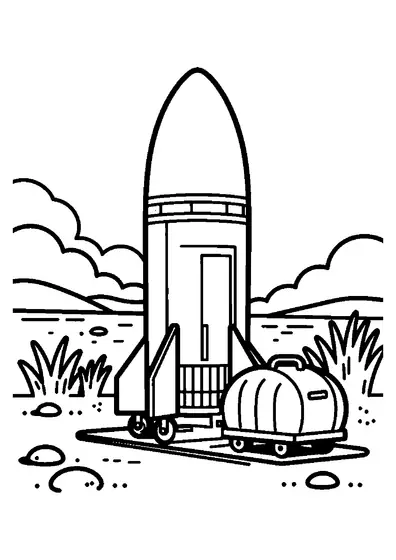
Rocket by the Ice Crevasse
A research landing craft rests near a deep glacial chasm accompanied by a heavy cargo sled amidst rolling frozen hills.

A4 format (portrait), black outlines on a white background · for home and classroom use
All coloring pages: Space and Rocket Coloring Pages
Similar coloring pages: Space and Rocket Coloring Pages


What else can you print? Free, no account needed
Custom Name Coloring Pages
Enter your child's name to generate a custom coloring page featuring large outline letters to color and decorate.
Open generator →Connect the Dots Generator
Eight connect-the-dots pictures across three difficulty levels. Features faint outline guides for younger children and dots only for older kids.
Open generator →Printables
Worksheets, tracing lines, mazes and dot-to-dots in A4.
Browse printables →
Surface Operations in Polar Environments
This setting illustrates a specialized research rocket stationed on a frozen surface adjacent to a deep ice crevasse. Positioned on the snow-covered ground nearby, a rugged transport sled supports field operations and gear transfer across slippery terrain. Sweeping icy hills surround the landing zone, marking an extreme environment dedicated to polar science.
Glacial Features and Polar Science Stations
Crevasses form when stress caused by glacial motion fractures brittle surface ice, creating deep vertical fissures that can extend hundreds of feet down. Research teams use heavy sleds equipped with wide tracks or skids to distribute weight evenly when navigating frozen fields. Studying polar ice caps allows researchers to analyze historic atmospheric layers preserved in deep ice cores.
Natural Shades of Polar Landscapes
- Research rocket: High-visibility polar white with thermal orange markings
- Heavy transport sled: Industrial yellow or dark steel blue
- Glacial ice crevasse: Deep azure blue, cyan, and translucent navy shadow
- Snow fields and hills: Crisp white, light powder blue, and soft gray shadows