
Rocket by a Weather Satellite
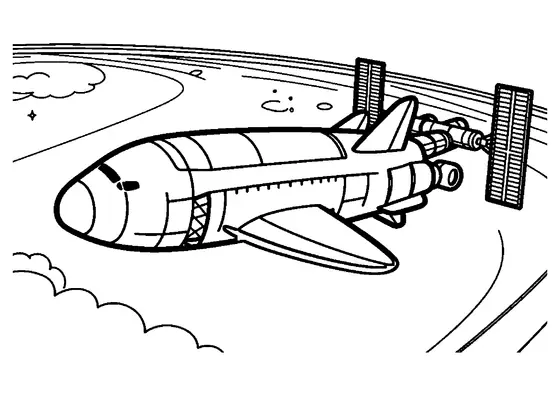
A rocket sails through orbit alongside a weather satellite equipped with large solar panels high above cloud-covered planet Earth.

A4 format (landscape), black outlines on a white background · for home and classroom use
All coloring pages: Space and Rocket Coloring Pages
Similar coloring pages: Space and Rocket Coloring Pages


What else can you print? Free, no account needed
Custom Name Coloring Pages
Enter your child's name to generate a custom coloring page featuring large outline letters to color and decorate.
Open generator →Connect the Dots Generator
Eight connect-the-dots pictures across three difficulty levels. Features faint outline guides for younger children and dots only for older kids.
Open generator →Printables
Worksheets, tracing lines, mazes and dot-to-dots in A4.
Browse printables →
Orbital Rendezvous with a Weather Satellite
A space rocket maneuvers through low Earth orbit right next to an operational weather satellite. Below the spacecraft, sweeping cloud formations cover the surface of Earth while the satellite extends its large solar arrays to absorb sunlight.
Satellite Meteorology and Orbital Science
Weather satellites maintain constant surveillance over global atmospheric conditions from orbital altitudes. Sensors detect ocean temperatures, cloud movements, and moisture levels to predict storms and track climate patterns. Solar panels convert solar radiation into electricity, powering continuous data transmissions to ground stations across the globe.
Colors of Spacecraft in Earth Orbit
- Rocket body: Glossy white with dark carbon-fiber trim
- Satellite body: Gold foil thermal blanket with silver instrument booms
- Solar panels: Deep sapphire blue or dark purple with grid lines
- Planet Earth: Royal blue oceans, bright white clouds, and green continents