
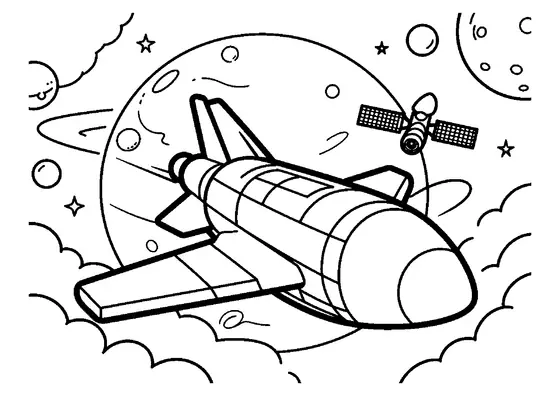
Rocket Above Venusian Clouds
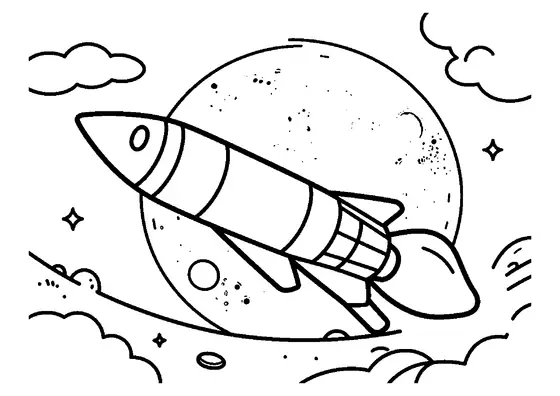
An exploration vessel glides through atmospheric cloud bands near a space probe hovering close to a massive planet.

A4 format (landscape), black outlines on a white background · for home and classroom use
All coloring pages: Space and Rocket Coloring Pages
Similar coloring pages: Space and Rocket Coloring Pages

What else can you print? Free, no account needed
Custom Name Coloring Pages
Enter your child's name to generate a custom coloring page featuring large outline letters to color and decorate.
Open generator →Connect the Dots Generator
Eight connect-the-dots pictures across three difficulty levels. Features faint outline guides for younger children and dots only for older kids.
Open generator →Printables
Worksheets, tracing lines, mazes and dot-to-dots in A4.
Browse printables →
Atmospheric Exploration Above Cloud Bands
An exploration spacecraft maneuvers high above dense planetary cloud bands alongside an automated space probe. Sweeping layers of cloud cover cloak the planet below, concealing its surface under thick atmospheric vapor. The presence of the specialized probe allows for atmospheric sampling and orbital communication while the main vessel navigates the upper cloud layer.
Atmospheric Structure of Venus and Cloud-Covered Planets
Planets with dense atmospheres, such as Venus, are covered by permanent layers of thick clouds that reflect sunlight and trap heat beneath. These cloud layers are composed mainly of sulfuric acid drops and carbon dioxide vapor, moving around the planet at high wind speeds. Robotic probes sent into such environments must be shielded with specialized materials to survive extreme pressure and acidic conditions.
Actual Colors of Planetary Atmospheres
- Exploration craft: Polished titanium silver with gold-foil solar shielding
- Robotic probe: Bronze metallic framing with dark blue sensor panels
- Atmospheric clouds: Pale cream, yellowish tan, and soft peach vapor layers
- Underlying planet haze: Warm amber fading into pale yellow upper atmosphere
- Background sky: Deep violet or dark sky gradient at extreme altitude