
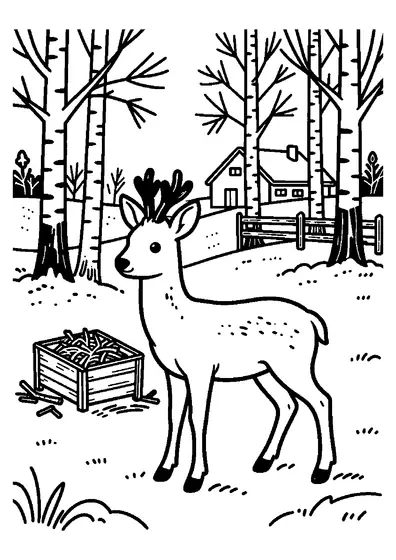
Young Deer at a Winter Forest Feeder
A young deer stands beside a wooden hay feeder situated at the edge of a snowy forest.

A4 format (portrait), black outlines on a white background · for home and classroom use
All coloring pages: Winter Coloring Pages
Similar coloring pages: Winter Coloring Pages


What else can you print? Free, no account needed
Custom Name Coloring Pages
Enter your child's name to generate a custom coloring page featuring large outline letters to color and decorate.
Open generator →Connect the Dots Generator
Eight connect-the-dots pictures across three difficulty levels. Features faint outline guides for younger children and dots only for older kids.
Open generator →Printables
Worksheets, tracing lines, mazes and dot-to-dots in A4.
Browse printables →
Young Deer Visiting Forest Feeders in Winter
Forest wildlife often seeks out supplementary food sources during cold months when deep snow covers natural ground vegetation. Young deer visit wooden forest feeders filled with dry hay to maintain energy levels through severe weather. These feeding stations are typically placed near woodland edges where animals can retreat into dense tree cover.
Winter Survival Strategies of Forest Deer
During winter, deer undergo physiological changes, including growing a thick winter coat composed of hollow guard hairs that trap warm body air. Their metabolism slows down automatically to conserve energy when wild food becomes scarce in snow-covered woods. Foresters and wildlife conservationists stock wooden feeders with dry forage to support deer populations during periods of heavy snowfall.
Natural Colors of Woodland Deer and Feeders
- Deer coat fur: reddish-brown in summer turning to muted grayish-brown in winter
- Deer tail underside: bright white fur
- Wooden feeder: weathered timber brown, gray pine, or mossy bark
- Dry hay forage: muted golden yellow or pale tan