
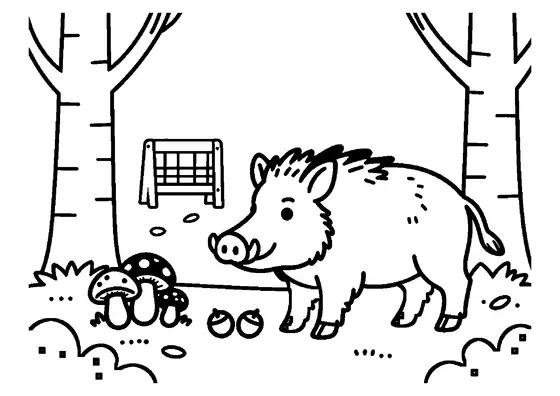
Wild Boar beside Black Trumpet Mushrooms
A wild boar moves through a forest setting filled with beech and oak trees beside unique black trumpet mushrooms.

A4 format (landscape), black outlines on a white background · for home and classroom use
All coloring pages: Mushroom Coloring Pages
Similar coloring pages: Mushroom Coloring Pages



What else can you print? Free, no account needed
Custom Name Coloring Pages
Enter your child's name to generate a custom coloring page featuring large outline letters to color and decorate.
Open generator →Connect the Dots Generator
Eight connect-the-dots pictures across three difficulty levels. Features faint outline guides for younger children and dots only for older kids.
Open generator →Printables
Worksheets, tracing lines, mazes and dot-to-dots in A4.
Browse printables →
A Wild Boar Foraging Among Rare Black Trumpet Mushrooms
A wild boar travels beneath an old oak tree and beech foliage near clusters of black trumpet mushrooms. These unusual funnel-shaped fungi grow along the damp forest floor where wild boars search for roots and fallen acorns. The woodland environment provides rich soil where both wild animals and wild edible mushrooms coexist.
Understanding Wild Boar Habits and Black Trumpet Fungi
Black trumpet mushrooms, also known as horns of plenty, possess a distinctive dark color that blends so well into decaying autumn leaves that foragers often find them challenging to spot. Wild boars use their tough, muscular snouts to dig into the topsoil in search of roots, bulbs, and subterranean fungi like truffles. Beech and oak woodlands are ideal environments for these animals because dropped acorns and beech masts supply rich seasonal nutrition.
Realistic Color Palette of Forest Boars and Fungi
- Wild boar coat: Dark brown, coarse gray, or charcoal black bristles
- Wild boar snout and hooves: Dark slate gray or grayish black
- Black trumpet mushrooms: Charcoal black to dark smoky brown on top, with gray undersides
- Oak tree trunk and beech bark: Deep brown to silver-gray bark texture
- Forest leaf litter: Russet brown, golden tan, and damp earth tones