
Boy with a Flashlight and Honey Mushrooms
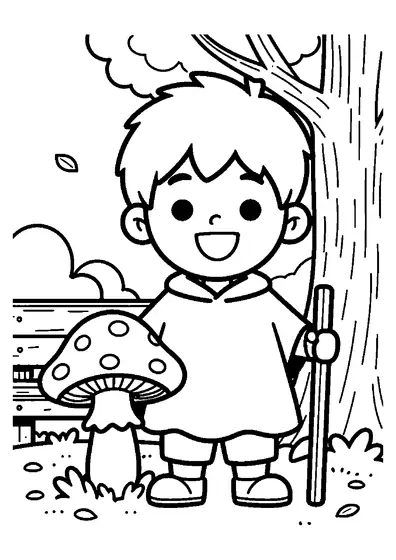
A curious boy shines his flashlight on a cluster of honey mushrooms sprouting from an old tree stump in an autumn forest.

A4 format (portrait), black outlines on a white background · for home and classroom use
All coloring pages: Mushroom Coloring Pages
Similar coloring pages: Mushroom Coloring Pages



What else can you print? Free, no account needed
Custom Name Coloring Pages
Enter your child's name to generate a custom coloring page featuring large outline letters to color and decorate.
Open generator →Connect the Dots Generator
Eight connect-the-dots pictures across three difficulty levels. Features faint outline guides for younger children and dots only for older kids.
Open generator →Printables
Worksheets, tracing lines, mazes and dot-to-dots in A4.
Browse printables →
Forest Exploration Under Autumn Trees
A young boy uses a handheld flashlight to observe honey mushrooms growing on a decaying tree stump in an autumn woodland. The scene focuses on nighttime or shaded forest discovery, highlighting fungal growth on old wood surrounded by fall nature.
Marvels of Honey Mushrooms and Fallen Trees
Honey mushrooms grow in dense clusters on rotting wood, breaking down dead tree stumps and returning organic nutrients back into woodland soil. Some species within the honey mushroom family exhibit bioluminescence, emitting a faint green glow under complete darkness. Flashlights help outdoor explorers spot small ecological details hidden in shady autumn underbrush.
True Colors of Autumn Wood Fungi
- Honey mushroom caps: Honey-yellow, golden amber, or yellowish-brown
- Old tree stump wood: Dark weathered brown with gray bark strips
- Flashlight casing: Bright yellow, red, or durable black plastic
- Autumn fallen leaves: Deep golden orange, rust red, and dry tan