
Frost on a Maple Leaf
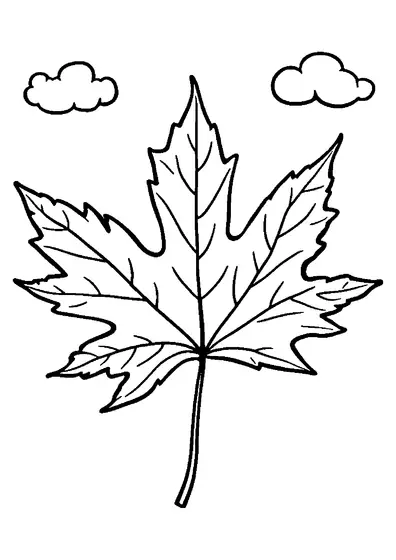
A single maple leaf seen from above carries a frosty coating across its pointed shape and branching veins.

A4 format (landscape), black outlines on a white background · for home and classroom use
All coloring pages: Fall Leaves and Chestnuts Coloring Pages
Similar coloring pages: Fall Leaves and Chestnuts Coloring Pages


What else can you print? Free, no account needed
Custom Name Coloring Pages
Enter your child's name to generate a custom coloring page featuring large outline letters to color and decorate.
Open generator →Connect the Dots Generator
Eight connect-the-dots pictures across three difficulty levels. Features faint outline guides for younger children and dots only for older kids.
Open generator →Printables
Worksheets, tracing lines, mazes and dot-to-dots in A4.
Browse printables →
Frost on a Maple Leaf
The large leaf is presented by itself, allowing its familiar lobes, finely toothed edges, central stem, and radiating veins to remain the focus. Frost covers the maple leaf after cold, moist air has settled around it. Its branching vein pattern shows the routes that once carried water and sugars through the living leaf.
Frost and Maple Leaf Facts
Frost forms when water vapor changes into ice crystals on a surface that is cold enough. Leaves can collect frost especially readily on clear, calm nights because they lose heat to the open sky. As sunlight warms the surface later, the crystals melt into tiny drops of water or return directly to vapor.
Real-World Colors of the Leaf and Frost
- Frost crystals: white, silvery, or nearly transparent
- Maple leaf in summer: usually medium or deep green
- Maple leaf in fall: yellow, orange, red, burgundy, or brown depending on the tree
- Main veins: pale green, yellow, reddish, or brown as the leaf ages
- Leaf stem: green on a fresh leaf and often red or brown later in the season