
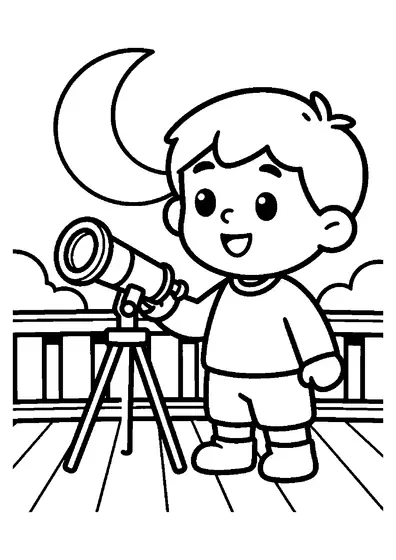
Young Astronomer at a Telescope in an Observatory
Astronomy allows curious minds to explore distant stars and planets through specialized optical instruments inside dome observatories.

A4 format (portrait), black outlines on a white background · for home and classroom use
All coloring pages: Printable Coloring Pages for Kids
Similar coloring pages: Printable Coloring Pages for Kids



What else can you print? Free, no account needed
Custom Name Coloring Pages
Enter your child's name to generate a custom coloring page featuring large outline letters to color and decorate.
Open generator →Connect the Dots Generator
Eight connect-the-dots pictures across three difficulty levels. Features faint outline guides for younger children and dots only for older kids.
Open generator →Printables
Worksheets, tracing lines, mazes and dot-to-dots in A4.
Browse printables →
Observing the Night Sky with Astronomical Telescopes
Astronomers study celestial bodies by pointing powerful optical telescopes toward the night sky from inside specialized observatory structures. The protective dome of an astronomical observatory houses large optical equipment that can rotate to track stars across the sky. Young stargazers learn to navigate constellations and observe planetary features while standing beside these large scientific instruments.
Fascinating Facts About Astronomical Observatories
Most major astronomical observatories are located on remote mountain peaks to avoid urban light pollution and atmospheric interference. The hemispherical dome of an observatory features a sliding shutter opening that allows the telescope to view specific celestial coordinates without exposing the entire room to cold night air. Modern astronomical telescopes do not rely solely on human eyes; they collect light over long exposure times using digital sensors.
Realistic Colors of Observatory Equipment and Space
- Large astronomical telescope: metallic gray, glossy white, or matte black steel
- Observatory dome exterior: reflective white or metallic silver to prevent heat absorption during daytime hours
- Short spiky hair of the young astronomer: natural brown, black, blonde, or dark red
- Astronomer's clothing: practical everyday colors such as navy blue, green, or maroon