
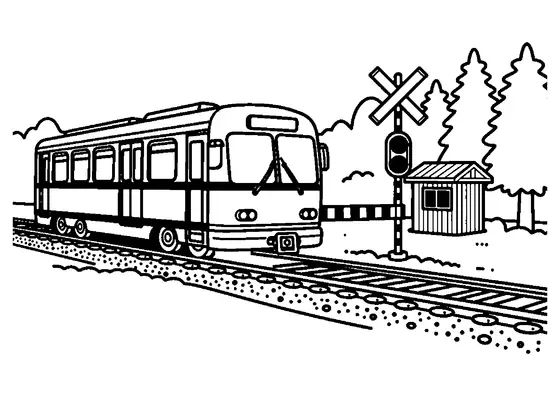
Steam Train at a Country Railroad Crossing
A vintage locomotive travels through rural tracks past a station house and safety barrier.

A4 format (landscape), black outlines on a white background · for home and classroom use
All coloring pages: Printable Coloring Pages for Kids
Similar coloring pages: Printable Coloring Pages for Kids


What else can you print? Free, no account needed
Custom Name Coloring Pages
Enter your child's name to generate a custom coloring page featuring large outline letters to color and decorate.
Open generator →Connect the Dots Generator
Eight connect-the-dots pictures across three difficulty levels. Features faint outline guides for younger children and dots only for older kids.
Open generator →Printables
Worksheets, tracing lines, mazes and dot-to-dots in A4.
Browse printables →
Steam Locomotive at a Rural Station Crossing
Steam trains were once the main form of long-distance transport, moving passengers and freight across country landscapes. These locomotives relied on burning coal or wood to boil water, producing pressurized steam that drove large steel wheels. Railroad crossings, signals, and nearby stations helped stationmasters direct traffic safely along rural tracks.
Rural Railroad History
Country railroad crossings relied on manual signals and wooden gates to stop horse-drawn carriages and early automobiles. Station buildings served as local hubs where cargo was stored, news was shared, and passengers waited for scheduled arrivals. Coal towers and water cranes along the line allowed trains to refill steam boilers between long journeys.
Real Colors of Steam Trains and Railway Facilities
- Train boiler and cab: Dark black, charcoal, or deep olive green
- Steam train wheels and side rods: Metallic gray, dark steel, or red paint on wheel spokes
- Signal box walls: Weathered red brick, beige timber, or white painted wood
- Railroad crossing gate arm: Alternating red and white stripes
- Railway station roof: Dark brown shingles, terracotta tiles, or slate gray paneling