
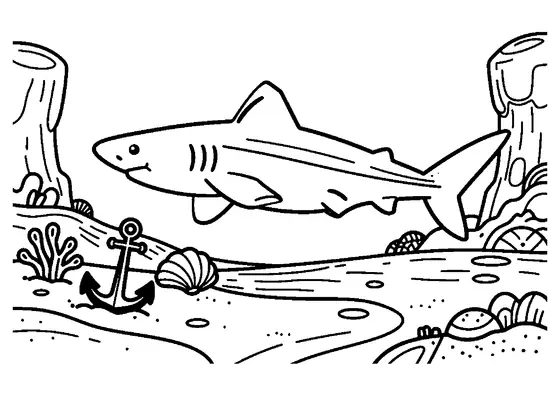
Shark Above the Ocean Floor
A predatory marine fish swims effortlessly over the ocean seabed past scattered seashells and a heavy sunken anchor.

A4 format (landscape), black outlines on a white background · for home and classroom use
All coloring pages: Printable Coloring Pages for Kids
Similar coloring pages: Printable Coloring Pages for Kids



What else can you print? Free, no account needed
Custom Name Coloring Pages
Enter your child's name to generate a custom coloring page featuring large outline letters to color and decorate.
Open generator →Connect the Dots Generator
Eight connect-the-dots pictures across three difficulty levels. Features faint outline guides for younger children and dots only for older kids.
Open generator →Printables
Worksheets, tracing lines, mazes and dot-to-dots in A4.
Browse printables →
Marine Shark Swimming Over the Seabed
A streamlined sea predator glides through open ocean water just above the sandy sea floor. Resting below on the ocean bottom are decorative seashells alongside a rusted sunken anchor from a sea vessel.
Ocean Science Facts About Marine Sharks and Shipwreck Artifacts
Sharks possess a special sensory system called ampullae of Lorenzini, which detects weak electrical fields produced by prey hiding beneath the sandy ocean floor. Sunken anchors made of heavy iron slowly turn into artificial reefs underwater, attracting marine life and shell-forming organisms over time.
Natural Colors of Marine Life and Underwater Objects
- Shark body: Countershaded dark slate gray or steel blue on top, with a clean white underside
- Sunken anchor: Rusted reddish-brown, dark cast iron gray, or covered in coral orange patches
- Seashells: Creamy white, soft pink, pastel orange, or beige depending on shell species
- Ocean floor sand: Pale tan, golden beige, or fine white coral sand
- Deep ocean water: Gradient of bright turquoise to deep navy blue