
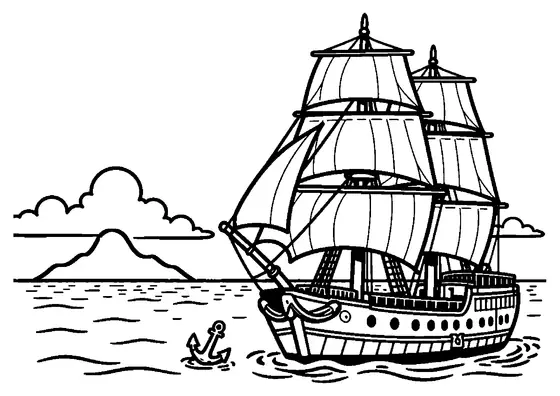
Sailing Ship on the Open Sea
A historic tall vessel journeys across rolling deep water with its expansive canvas fabric fully unfurled.

A4 format (landscape), black outlines on a white background · for home and classroom use
All coloring pages: Printable Coloring Pages for Kids
Similar coloring pages: Printable Coloring Pages for Kids
What else can you print? Free, no account needed
Custom Name Coloring Pages
Enter your child's name to generate a custom coloring page featuring large outline letters to color and decorate.
Open generator →Connect the Dots Generator
Eight connect-the-dots pictures across three difficulty levels. Features faint outline guides for younger children and dots only for older kids.
Open generator →Printables
Worksheets, tracing lines, mazes and dot-to-dots in A4.
Browse printables →
Historic Vessel Traversing Ocean Waves
A broad wooden ocean vessel navigates open water under full canvas power. Elevated sails catch strong maritime breezes to propel the traditional multi-masted ship across rolling ocean swells.
Principles of Wind-Powered Ocean Travel
Traditional wooden vessels rely on complex rigging, ropes, and adjustable canvas cloth to harness wind energy from various directions. Skilled crews adjust the angle of individual sails relative to the wind to steer complex ocean routes without mechanical engines.
Natural Colors of Classic Sailing Ships
- Wooden Ship Hull: Rich chestnut brown, dark oak, or weathered timber
- Raised Sails: Off-white, pale cream, or light tan cotton fabric
- Ocean Waves: Deep ocean blue, turquoise, or seafoam green foam
- Vessel Wooden Deck: Natural teak brown or weathered gray timber