
Glider on a Grassy Airfield
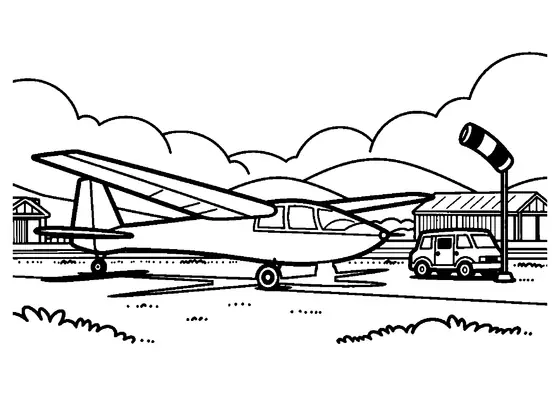
A sleek sailplane rests on an open grassy field near an airfield control tower and windsock.

A4 format (landscape), black outlines on a white background · for home and classroom use
All coloring pages: Printable Coloring Pages for Kids
Similar coloring pages: Printable Coloring Pages for Kids


What else can you print? Free, no account needed
Custom Name Coloring Pages
Enter your child's name to generate a custom coloring page featuring large outline letters to color and decorate.
Open generator →Connect the Dots Generator
Eight connect-the-dots pictures across three difficulty levels. Features faint outline guides for younger children and dots only for older kids.
Open generator →Printables
Worksheets, tracing lines, mazes and dot-to-dots in A4.
Browse printables →
Unpowered Glider Resting on an Airfield Runway
A sleek glider is parked on a lush grassy airfield after a long flight. Beside the unpowered aircraft sits a small ground utility cart, while a bright windsock flutters on a pole nearby and an airfield control tower stands in the background. The open airfield setting reflects the peaceful nature of soaring aviation.
The Physics of Soaring in Unpowered Sailplanes
Gliders are specially engineered aircraft built without engines that rely entirely on natural air currents to stay aloft for hours. Pilots take advantage of rising columns of warm air called thermals to gain altitude before gliding across long distances. Because gliders have extremely long, narrow wings, they experience very little aerodynamic drag, allowing them to glide smoothly for dozens of miles from great heights.
Standard Colors of Gliders and Airfield Equipment
- Glider fuselage and wings: Brilliant pure white with red or navy blue wingtips
- Windsock: Vibrant orange, bright white, or alternating orange-and-white bands
- Airfield control tower: Light gray concrete, white painted walls, or dark glass windows
- Ground utility cart: Industrial yellow, dark red, or utilitarian dark gray
- Airfield grass: Bright green, emerald, or sun-cured yellow-green