
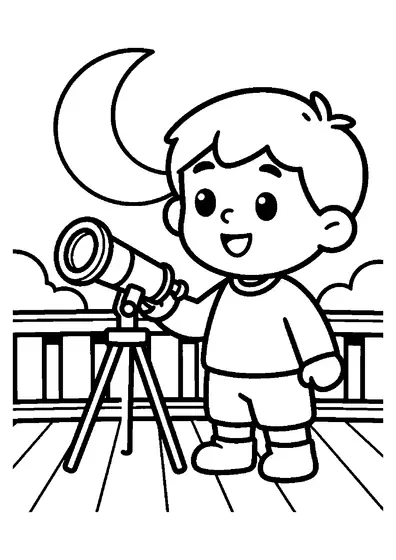
Boy Using a Telescope in an Observatory Dome
Dome observatories house large optical instruments designed to observe distant stars and celestial objects clearly.

A4 format (portrait), black outlines on a white background · for home and classroom use
All coloring pages: Printable Coloring Pages for Kids
Similar coloring pages: Printable Coloring Pages for Kids



What else can you print? Free, no account needed
Custom Name Coloring Pages
Enter your child's name to generate a custom coloring page featuring large outline letters to color and decorate.
Open generator →Connect the Dots Generator
Eight connect-the-dots pictures across three difficulty levels. Features faint outline guides for younger children and dots only for older kids.
Open generator →Printables
Worksheets, tracing lines, mazes and dot-to-dots in A4.
Browse printables →
Stargazing Inside an Astronomical Observatory
Observatories provide optimal conditions for analyzing distant planets, nebulae, and stellar formations. Inside the protective dome, large astronomical telescopes gather faint light from outer space, giving young space enthusiasts a clear view of cosmic phenomena.
How Observatory Domes Function
The rounded roof of an astronomical observatory rotates three hundred sixty degrees to align with celestial targets anywhere in the sky. Slit openings in the dome allow the main telescope tube to point outdoors while shielding sensitive instruments from wind and stray lighting.
Real Colors of an Astronomical Observatory
- Telescope tube: crisp white, metallic silver, or matte dark blue
- Observatory interior walls and floor: neutral light gray or dark blue finish
- Outer night sky: deep navy blue, indigo, or black with bright yellow stars
- Dome structural frame: silver aluminum or painted white steel panels