
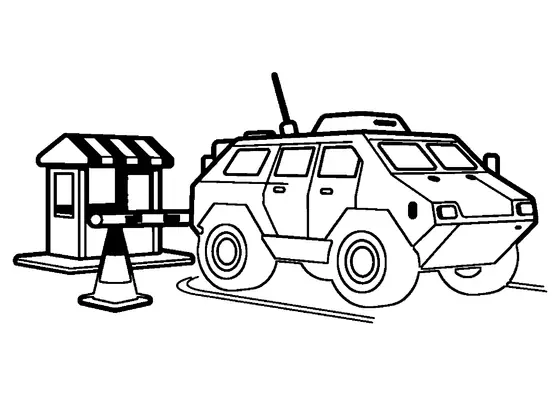
Armored Vehicle on an Urban Training Course
An armored vehicle navigates a mock city street built on an urban training course.

A4 format (portrait), black outlines on a white background · for home and classroom use
All coloring pages: Military Coloring Pages
Similar coloring pages: Military Coloring Pages



What else can you print? Free, no account needed
Custom Name Coloring Pages
Enter your child's name to generate a custom coloring page featuring large outline letters to color and decorate.
Open generator →Connect the Dots Generator
Eight connect-the-dots pictures across three difficulty levels. Features faint outline guides for younger children and dots only for older kids.
Open generator →Printables
Worksheets, tracing lines, mazes and dot-to-dots in A4.
Browse printables →
Armored Vehicle Driving Through a Mock City Street
An armored vehicle maneuvers along a paved training street designed to simulate an urban environment. Surrounding building fronts recreate a city block, complete with a safety barrier and a traffic cone marking the driver's route.
Why Drivers Practice on Urban Training Courses
Driving large armored vehicles through narrow city streets requires high precision and careful steering around tight corners. Specialized training courses feature dummy building facades and paved surfaces so drivers can practice tight maneuvers safely. Learning to navigate urban obstacles helps operators handle complex roadways without damaging surrounding structures.
Realistic Colors of Urban Training Elements
- Armored vehicle hull: urban gray, matte olive, or camouflage tan
- Paved street surface: light gray asphalt or weathered concrete slabs
- Building facades: brick red, beige plaster, or dark gray stone
- Safety barrier: bright yellow or silver metallic finish
- Traffic cone: high-visibility orange with white stripes