
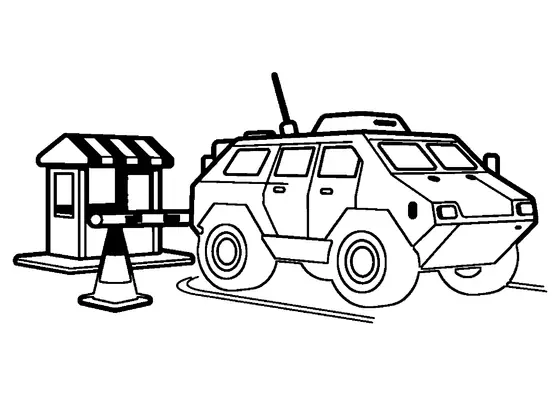
Armored Carrier at a River Crossing
A wheeled armored vehicle rests near a quiet river ferry ramp surrounded by early morning mist.

A4 format (landscape), black outlines on a white background · for home and classroom use
All coloring pages: Military Coloring Pages
Similar coloring pages: Military Coloring Pages




What else can you print? Free, no account needed
Custom Name Coloring Pages
Enter your child's name to generate a custom coloring page featuring large outline letters to color and decorate.
Open generator →Connect the Dots Generator
Eight connect-the-dots pictures across three difficulty levels. Features faint outline guides for younger children and dots only for older kids.
Open generator →Printables
Worksheets, tracing lines, mazes and dot-to-dots in A4.
Browse printables →
Wheeled Armored Carriers at River Crossings
A wheeled armored carrier is stationed by a river ferry ramp near the water's edge. Early morning mist hangs over the calm river scene, where a navigation buoy floats nearby and a coiled rope rests on the landing area.
Water Operations and River Transport
Military vehicles often use specialized ferry ramps or pontoon bridges to navigate rivers when permanent bridges are unavailable. Wheeled armored carriers are designed with high ground clearance and all-wheel drive systems to maintain traction on wet, muddy riverbanks. Navigational buoys help guide watercraft safely across deep river channels during ferry operations.
Natural Colors of Military Vehicles and Waterways
- Armored carrier body: Olive green, tan, or camouflage pattern
- Vehicle tires: Dark matte gray or black
- River water: Deep blue, green-gray, or brown depending on sediment
- Navigation buoy: Bright red, yellow, or white
- Coiled rope: Natural tan or hemp brown