
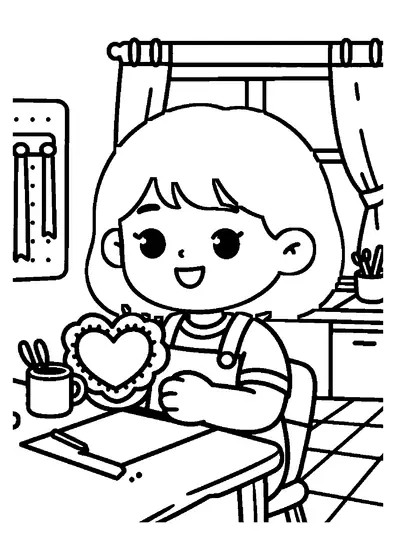
Girl Making a Heart-Shaped Mosaic in an Art Studio
A young girl in a protective apron carefully arranges colorful ceramic tiles to assemble a heart-shaped mosaic in an art studio.

A4 format (portrait), black outlines on a white background · for home and classroom use
All coloring pages: Valentine's Day Coloring Pages
Similar coloring pages: Valentine's Day Coloring Pages



What else can you print? Free, no account needed
Custom Name Coloring Pages
Enter your child's name to generate a custom coloring page featuring large outline letters to color and decorate.
Open generator →Connect the Dots Generator
Eight connect-the-dots pictures across three difficulty levels. Features faint outline guides for younger children and dots only for older kids.
Open generator →Printables
Worksheets, tracing lines, mazes and dot-to-dots in A4.
Browse printables →
Creating a Heart-Shaped Mosaic in an Art Studio
Inside a creative art studio, a girl wearing a workshop apron carefully positions small ceramic tiles to craft a mosaic artwork shaped like a heart. Studio spaces provide specialized tools and materials needed for mosaic craft projects. Assembling individual geometric pieces into a unified design requires patience and precision.
Historical and Artistic Facts About Mosaic Crafts
Mosaic creation is an ancient art form dating back thousands of years to early civilizations in Mesopotamia and Ancient Greece. Artists craft intricate patterns by fitting together small pieces of colored stone, glass, or glazed ceramic tiles known as tesserae. Once placed, these individual pieces are secured in mortar and sealed with grout to form durable, permanent designs.
Typical Colors in Ceramic Mosaics and Studio Spaces
- Ceramic tiles: Bright turquoise, scarlet red, sunny yellow, and royal blue
- Protective apron: Canvas beige, denim blue, or olive green
- Tile grout: Neutral gray, off-white, or charcoal gray
- Wooden workbench: Warm pine or dark oak timber surface