
Fox in the Forest with a Heart-Shaped Pine Cone
A fluffy-tailed fox encounters an unusual heart-shaped pine cone in a sunny woodland clearing.

A4 format (landscape), black outlines on a white background · for home and classroom use
All coloring pages: Valentine's Day Coloring Pages
Similar coloring pages: Valentine's Day Coloring Pages



What else can you print? Free, no account needed
Custom Name Coloring Pages
Enter your child's name to generate a custom coloring page featuring large outline letters to color and decorate.
Open generator →Connect the Dots Generator
Eight connect-the-dots pictures across three difficulty levels. Features faint outline guides for younger children and dots only for older kids.
Open generator →Printables
Worksheets, tracing lines, mazes and dot-to-dots in A4.
Browse printables →
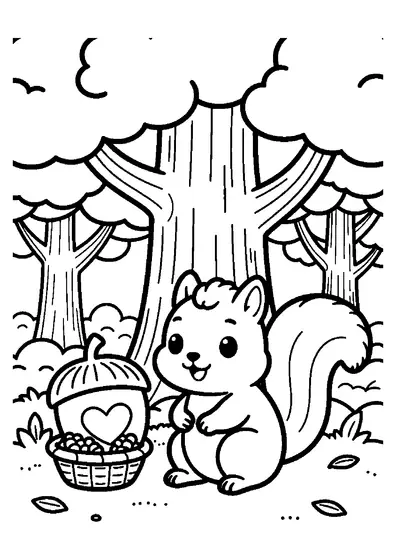
A Forest Fox and a Heart-Shaped Pine Cone
The scene follows a little fox in a bright forest clearing beside a large pine cone with the shape of a heart. The fox’s full tail and woodland surroundings reflect its life as a forest animal, while the unusual cone brings a Valentine’s Day symbol into nature. Sunlight gives the clearing a warm outdoor atmosphere.
Fox and Pine Cone Facts
Foxes use their sharp hearing to locate small animals moving beneath leaves, grass, or even snow. Pine cones protect a tree’s seeds between woody scales, and many cones open as they dry so the seeds can be carried away by wind.
Colors Found in Real Life
- Fox coat: rusty orange, red-brown, sandy tan, silver, or gray depending on the species and individual
- Fox chest and tail tip: often cream or white
- Fox legs and ears: commonly dark brown or black on a red fox
- Pine cone: green while developing, then tan or brown when mature
- Forest ground: brown, green, or golden where sunlight reaches the clearing