
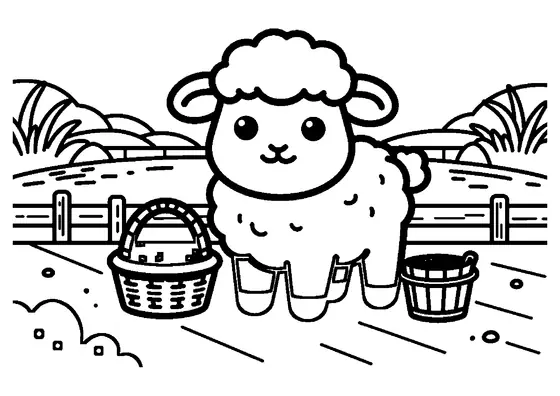
Fluffy Lamb Beside a Wooden Watermill
A fluffy Easter lamb rests by a stream near the old wooden wheel of a watermill in a peaceful country setting.

A4 format (landscape), black outlines on a white background · for home and classroom use
All coloring pages: Easter Coloring Pages
Similar coloring pages: Easter Coloring Pages




What else can you print? Free, no account needed
Custom Name Coloring Pages
Enter your child's name to generate a custom coloring page featuring large outline letters to color and decorate.
Open generator →Connect the Dots Generator
Eight connect-the-dots pictures across three difficulty levels. Features faint outline guides for younger children and dots only for older kids.
Open generator →Printables
Worksheets, tracing lines, mazes and dot-to-dots in A4.
Browse printables →
What appears beside the wooden watermill
A small lamb with soft, fluffy wool is shown beside an old wooden watermill and its large wheel. A nearby stream supplies the natural setting associated with the mill. The resting lamb, flowing water, aged wood, and mill wheel bring a gentle Easter theme into a traditional rural scene without suggesting that the animal operates the machinery.
Surprising facts about watermills and streams
A watermill uses moving water to turn a wheel, and that rotation can transfer power to machinery inside the mill. Watermills have commonly been used to grind grain, although water power has also supported other kinds of work. Streams are habitats as well as sources of energy, so clean, moving water can support many forms of life.
Natural colors of lambs and old watermills
- Lamb's wool: white, cream, brown, black, gray, or a mixture of shades
- Lamb's face and legs: cream, tan, brown, gray, black, or pinkish in lightly covered areas
- Wooden mill wheel: warm brown, dark brown, or weathered gray
- Stream water: usually clear, reflecting blue, gray, green, or brown from its surroundings
- Old wooden mill: tan, brown, deep brown, or silvery gray where the wood has weathered