
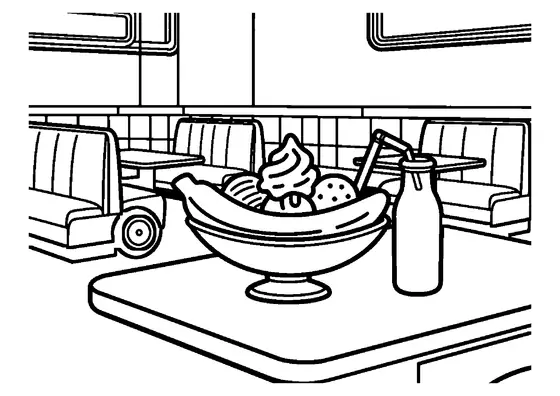
Banana Split on a Diner Table
A classic banana split with ice cream scoops rests in an elongated glass dish on a cozy diner table.

A4 format (landscape), black outlines on a white background · for home and classroom use
All coloring pages: Ice Cream and Dessert Coloring Pages
Similar coloring pages: Ice Cream and Dessert Coloring Pages




What else can you print? Free, no account needed
Custom Name Coloring Pages
Enter your child's name to generate a custom coloring page featuring large outline letters to color and decorate.
Open generator →Connect the Dots Generator
Eight connect-the-dots pictures across three difficulty levels. Features faint outline guides for younger children and dots only for older kids.
Open generator →Printables
Worksheets, tracing lines, mazes and dot-to-dots in A4.
Browse printables →
Classic Banana Split at a Diner Table
The traditional banana split features a peeled banana sliced lengthwise to cradle several distinct ice cream scoops. Diners serve this iconic dessert in long oval glass boats designed specifically to support the fruit slices alongside rich toppings. Tabletop seating in vintage restaurants offers a cozy setting for enjoying multi-layered ice cream treats.
History of Diner Desserts
The banana split was invented in Latrobe, Pennsylvania, in 1904 by a pharmacy apprentice named David Evans Strickler who liked experimenting with soda fountain treats. Glass boat dishes were custom manufactured in America to fit the exact length of standard Cavendish bananas. Traditional diners gained popularity in the 1920s as converted railcars turned into low-cost neighborhood eateries.
True Colors of a Banana Split
- Banana halves: Soft creamy yellow
- Vanilla ice cream scoop: Off-white or cream
- Chocolate ice cream scoop: Deep dark brown
- Strawberry ice cream scoop: Pastel pink
- Glass dish: Translucent clear with white highlights