
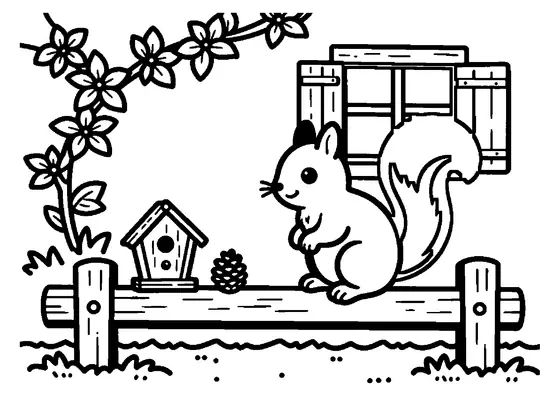
Squirrel by a Planter of Climbing Wisteria
A lively squirrel perches atop the rim of a planter while observing cascading clusters of purple wisteria flowers.

A4 format (landscape), black outlines on a white background · for home and classroom use
All coloring pages: Flower Coloring Pages
Similar coloring pages: Flower Coloring Pages


What else can you print? Free, no account needed
Custom Name Coloring Pages
Enter your child's name to generate a custom coloring page featuring large outline letters to color and decorate.
Open generator →Connect the Dots Generator
Eight connect-the-dots pictures across three difficulty levels. Features faint outline guides for younger children and dots only for older kids.
Open generator →Printables
Worksheets, tracing lines, mazes and dot-to-dots in A4.
Browse printables →
Garden Wildlife Near Hanging Wisteria Blooms
Decorative garden planters provide perfect vantage points for small woodland animals navigating outdoor spaces. Wisteria vines produce heavy, pendulous clusters of blossoms that drape gracefully over planter edges and garden trellises. Squirrels frequently explore container gardens while searching for seeds, nuts, or shaded resting spots beneath dense vine foliage.
Unique Characteristics of Wisteria Vines
Wisteria is a long-lived woody climbing vine capable of growing up stone walls and wooden support structures. The fragrant flower clusters can grow up to twenty inches long, opening in late spring before the leaves fully unfold. Some species of wisteria climb by twining their stems clockwise, while other varieties twine counter-clockwise around their supports.
Realistic Colors of Wisteria and Squirrels
- Wisteria flower clusters: lavender purple, deep violet, or soft blue-violet
- Wisteria vine leaves: bright pea green to medium olive green
- Decorative planter container: weathered stone gray, terracotta, or dark bronze
- Squirrel fur body: reddish brown, silvery gray, or warm chestnut
- Squirrel tail fur: bushy gray mixed with white tips