
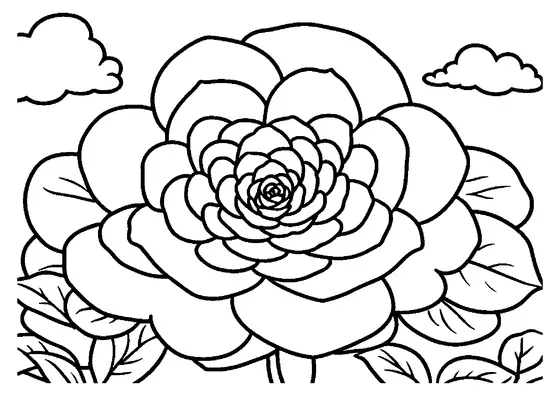
Large Gerbera Flower on a Stem
One fully open gerbera faces forward on a tall, straight stem against an empty background.

A4 format (portrait), black outlines on a white background · for home and classroom use
All coloring pages: Flower Coloring Pages
Similar coloring pages: Flower Coloring Pages


What else can you print? Free, no account needed
Custom Name Coloring Pages
Enter your child's name to generate a custom coloring page featuring large outline letters to color and decorate.
Open generator →Connect the Dots Generator
Eight connect-the-dots pictures across three difficulty levels. Features faint outline guides for younger children and dots only for older kids.
Open generator →Printables
Worksheets, tracing lines, mazes and dot-to-dots in A4.
Browse printables →
The Large Gerbera Flower
The page presents a single blooming gerbera viewed directly from the front. Numerous long petals spread outward around its circular center, creating the flower's familiar sunlike shape. A straight stem extends from the flower head to the lower edge, while the plain background leaves the gerbera as the only subject in the scene.
Surprising Facts About Gerberas
What appears to be one gerbera flower is actually a flower head made from many tiny individual flowers. The small flowers in the center form a compact disk, while the outer ray flowers look like petals. Gerberas belong to the daisy family and are widely grown as garden and cut flowers.
Natural Colors of a Gerbera
- Outer ray petals: naturally red, orange, yellow, pink, white, cream, or mixed shades
- Inner rings of tiny flowers: often yellow, orange, brown, green, or dark red
- Central disk: commonly golden, brown, green, or nearly black, depending on the variety
- Stem: fresh green to medium green
- Base of the flower head: usually green