
Three Long-Stemmed Roses
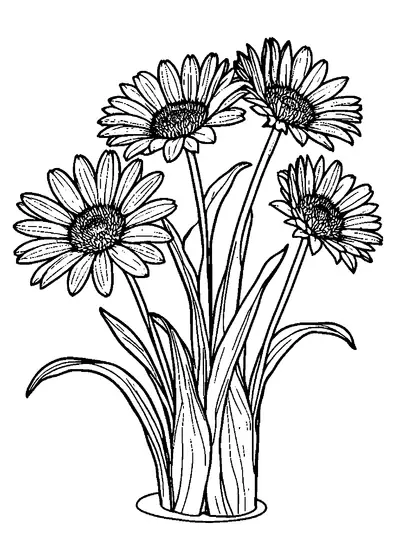
Three open roses rise on long upright stems, accompanied by elongated leaves and no surrounding scenery.

A4 format (portrait), black outlines on a white background · for home and classroom use
All coloring pages: Flower Bouquet and Wreath Coloring Pages
Similar coloring pages: Flower Bouquet and Wreath Coloring Pages



What else can you print? Free, no account needed
Custom Name Coloring Pages
Enter your child's name to generate a custom coloring page featuring large outline letters to color and decorate.
Open generator →Connect the Dots Generator
Eight connect-the-dots pictures across three difficulty levels. Features faint outline guides for younger children and dots only for older kids.
Open generator →Printables
Worksheets, tracing lines, mazes and dot-to-dots in A4.
Browse printables →
The Three Long-Stemmed Roses
This floral arrangement shows three developed rose blooms at the tops of tall, nearly vertical stems. Layered petals curl around each flower’s center, while leaves grow at intervals farther down the stems. The roses stand as a loose bouquet without a vase, ribbon, lettering, or other decorative objects.
Why Roses Have Thorns and Layered Petals
The sharp structures on rose stems are technically called prickles because they grow from the stem’s outer tissue rather than from deeper wood. They can discourage some animals from eating or damaging the plant. The layered appearance of many garden roses comes from selective breeding for blooms with additional petals.
Natural Colors of Long-Stemmed Roses
- Rose petals: red, pink, white, yellow, peach, orange, lavender, or blended shades
- Inner petals: often deeper or more shadowed than the outer petals
- Stems: medium to deep green, sometimes with reddish new growth
- Leaves: green with lighter undersides and occasionally red-bronze young tips
- Prickles: green on young stems, becoming tan or brown as they mature