
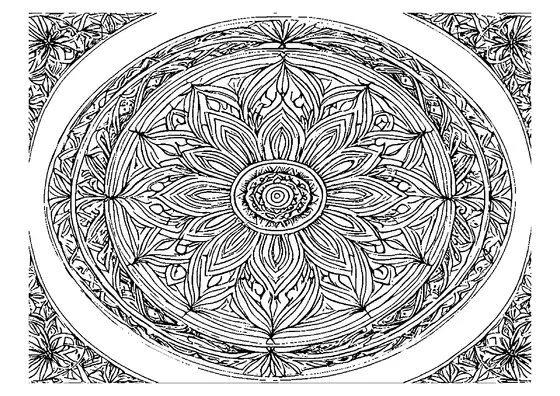
Floral Rosette Mandala
A symmetrical flower-inspired rosette fills a circle with a central disk and repeating layers of petals.

A4 format (portrait), black outlines on a white background · for home and classroom use
All coloring pages: Flower Coloring Pages
Similar coloring pages: Flower Coloring Pages


What else can you print? Free, no account needed
Custom Name Coloring Pages
Enter your child's name to generate a custom coloring page featuring large outline letters to color and decorate.
Open generator →Connect the Dots Generator
Eight connect-the-dots pictures across three difficulty levels. Features faint outline guides for younger children and dots only for older kids.
Open generator →Printables
Worksheets, tracing lines, mazes and dot-to-dots in A4.
Browse printables →
What the Floral Rosette Mandala Depicts
The design is arranged around one central point and enclosed by a large circle. Petal shapes repeat outward in balanced layers, creating a floral rosette that looks similar from several directions. Each surrounding section echoes another part of the pattern, giving the whole composition an orderly, radial structure.
Fascinating Facts About Rosettes and Radial Symmetry
A rosette is an ornamental design whose parts spread from the center like the petals of a flower. Radial symmetry also appears in many real blossoms, where petals are arranged around the flower's reproductive center. Artists and builders have used rosette patterns in textiles, carved decoration, mosaics, and windows across many cultures.
Colors Found in Real Flower Forms
- Flower centers: yellow, gold, green, brown, or nearly black
- Inner petals: white, cream, pink, red, purple, blue, or orange
- Outer petals: the same hue as the inner petals or a lighter shade
- Petal bases: often deeper or brighter than the tips
- Circular decorative border: any natural mineral or plant-dye color, including rust red, indigo, ochre, or green