
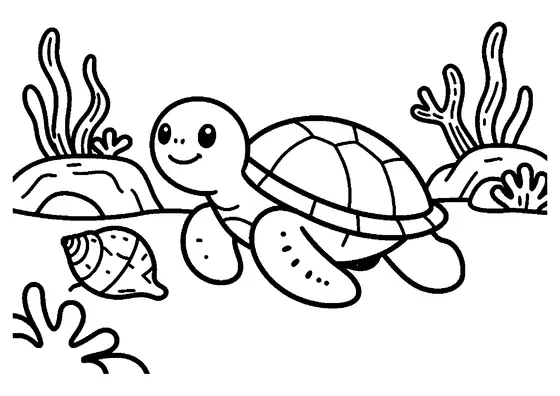
Young Sea Turtle by an Underwater Shell Ridge
An ocean scene features a juvenile sea turtle gliding along a sandy seabed ridge surrounded by cone shells and mushroom corals.

A4 format (landscape), black outlines on a white background · for home and classroom use
All coloring pages: Mermaid Coloring Pages
Similar coloring pages: Mermaid Coloring Pages



What else can you print? Free, no account needed
Custom Name Coloring Pages
Enter your child's name to generate a custom coloring page featuring large outline letters to color and decorate.
Open generator →Connect the Dots Generator
Eight connect-the-dots pictures across three difficulty levels. Features faint outline guides for younger children and dots only for older kids.
Open generator →Printables
Worksheets, tracing lines, mazes and dot-to-dots in A4.
Browse printables →
Sea Turtle Exploring a Reef Ridge
A young sea turtle glides quietly over a sandy underwater ledge. Along this ridge rest decorative ocean elements, including a distinct cone shell and low mushroom corals anchored to the seabed floor.
Ocean Habitats of Young Sea Turtles
Juvenile sea turtles often spend their early years feeding near coastal coral formations and shallow ridges where currents bring nutrient-rich waters. Mushroom corals form flat, disk-like shapes that provide shelter for small organisms, while cone shells rely on sandy floors to bury themselves when resting.
Natural Colors of Sea Turtles and Reef Elements
- Sea turtle shell: Olive-green, dark brown, or yellow-patterned bony plates
- Sea turtle skin: Pale gray or greenish-tan with dark markings on the flippers
- Cone shell: Cream white decorated with dark brown or reddish spiral pattern bands
- Mushroom coral: Soft brown, pinkish-gray, or tan tentacles and skeletal ridges