
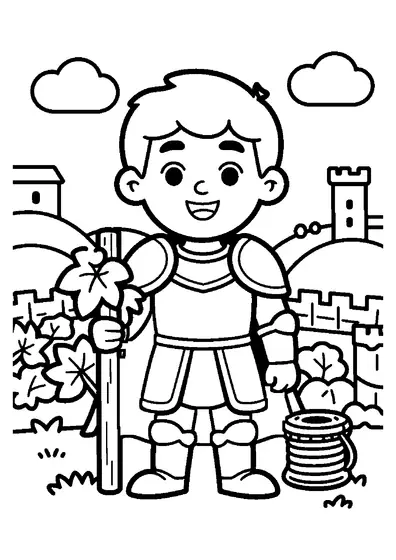
Knight Repairing Stone Steps
Careful restoration keeps the stone steps of a castle garden sturdy and safe for daily use.

A4 format (portrait), black outlines on a white background · for home and classroom use
All coloring pages: Knights and Castles Coloring Pages
Similar coloring pages: Knights and Castles Coloring Pages




What else can you print? Free, no account needed
Custom Name Coloring Pages
Enter your child's name to generate a custom coloring page featuring large outline letters to color and decorate.
Open generator →Connect the Dots Generator
Eight connect-the-dots pictures across three difficulty levels. Features faint outline guides for younger children and dots only for older kids.
Open generator →Printables
Worksheets, tracing lines, mazes and dot-to-dots in A4.
Browse printables →
A Knight Restoring Stone Steps in a Castle Garden
Castle gardens featured stone walkways and staircases connecting different terraces of the estate. Masonry tools like heavy hammers were essential for fitting large stone slabs precisely into place.
How Medieval Stone Structures Were Maintained
Stone steps in historical fortresses were crafted from sandstone, limestone, or granite to withstand heavy daily foot traffic. Masons used iron hammers and chisels to shape rough stone blocks so they would lay flat and secure. Castle gardens served as places for quiet walks, requiring regular maintenance to keep paths smooth.
Natural Colors of Stone and Garden Elements
- Stone slabs and steps: neutral light gray, beige, or slate gray
- Hammer head: dark metallic iron or dull steel
- Hammer handle: natural ash or hickory wood tone
- Garden foliage: varied shades of deep green and olive