
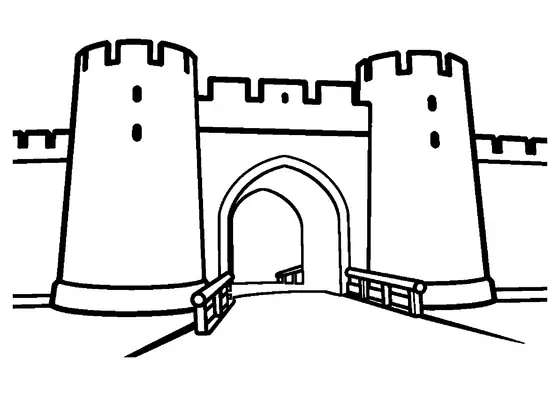
Drawbridge Over the Moat
A heavy wooden drawbridge extends across the water of a castle moat to reach the grassy bank.

A4 format (landscape), black outlines on a white background · for home and classroom use
All coloring pages: Knights and Castles Coloring Pages
Similar coloring pages: Knights and Castles Coloring Pages



What else can you print? Free, no account needed
Custom Name Coloring Pages
Enter your child's name to generate a custom coloring page featuring large outline letters to color and decorate.
Open generator →Connect the Dots Generator
Eight connect-the-dots pictures across three difficulty levels. Features faint outline guides for younger children and dots only for older kids.
Open generator →Printables
Worksheets, tracing lines, mazes and dot-to-dots in A4.
Browse printables →
Castle Drawbridges and Surrounding Moats
A drawbridge built over a water-filled moat provided a controllable crossing into a medieval fortress. By lowering the wooden platform onto the grassy embankment, castle inhabitants created a temporary bridge that could be instantly removed whenever danger approached.
Facts About Castle Moats and Water Barriers
Moats were engineered ditches filled with water, mud, or steep earth banks designed to prevent siege engines from reaching castle walls. Some moats drew water from nearby rivers or natural springs using dams and sluice gates to maintain constant water levels. The muddy banks also prevented attackers from digging tunnels under the stone foundations.
Authentic Colors of Moats and Drawbridges
- Wooden drawbridge planks: rich chestnut brown, weathered gray, or dark oak
- Moat water: deep emerald green, murky brown, or reflective navy blue
- Moat bank soil and grass: olive green, earth brown, or mossy yellow-green
- Lifting chains and metal rings: rusted dark brown or gunmetal gray